The AI edge is not where everyone is looking
SaaS isn't dying. The value is moving to a different layer, and so is the data that feeds it. There are two ways to get that data. One is slow and expensive. The other is now possible, and it compounds.
Explore our latest thinking on agentic AI, digital colleagues, and the future of enterprise transformation.

SaaS isn't dying. The value is moving to a different layer, and so is the data that feeds it. There are two ways to get that data. One is slow and expensive. The other is now possible, and it compounds.

EU compliance costs keep rising while AI costs collapse. Since regulations like EUDR and PPWR share the same operational skeleton, AI "digital colleagues" can handle the repetitive work on a shared platform, turning each new rule into a cheap hire rather than a costly project.

Relying on a single AI or cloud provider creates hidden costs, inefficiencies, and strategic risks while limiting flexibility, innovation, and compliance readiness. Using a multi-provider, agent-native architecture with open standards helps organizations reduce waste, avoid lock-in, and maintain control, turning AI into a more scalable and future-proof advantage.

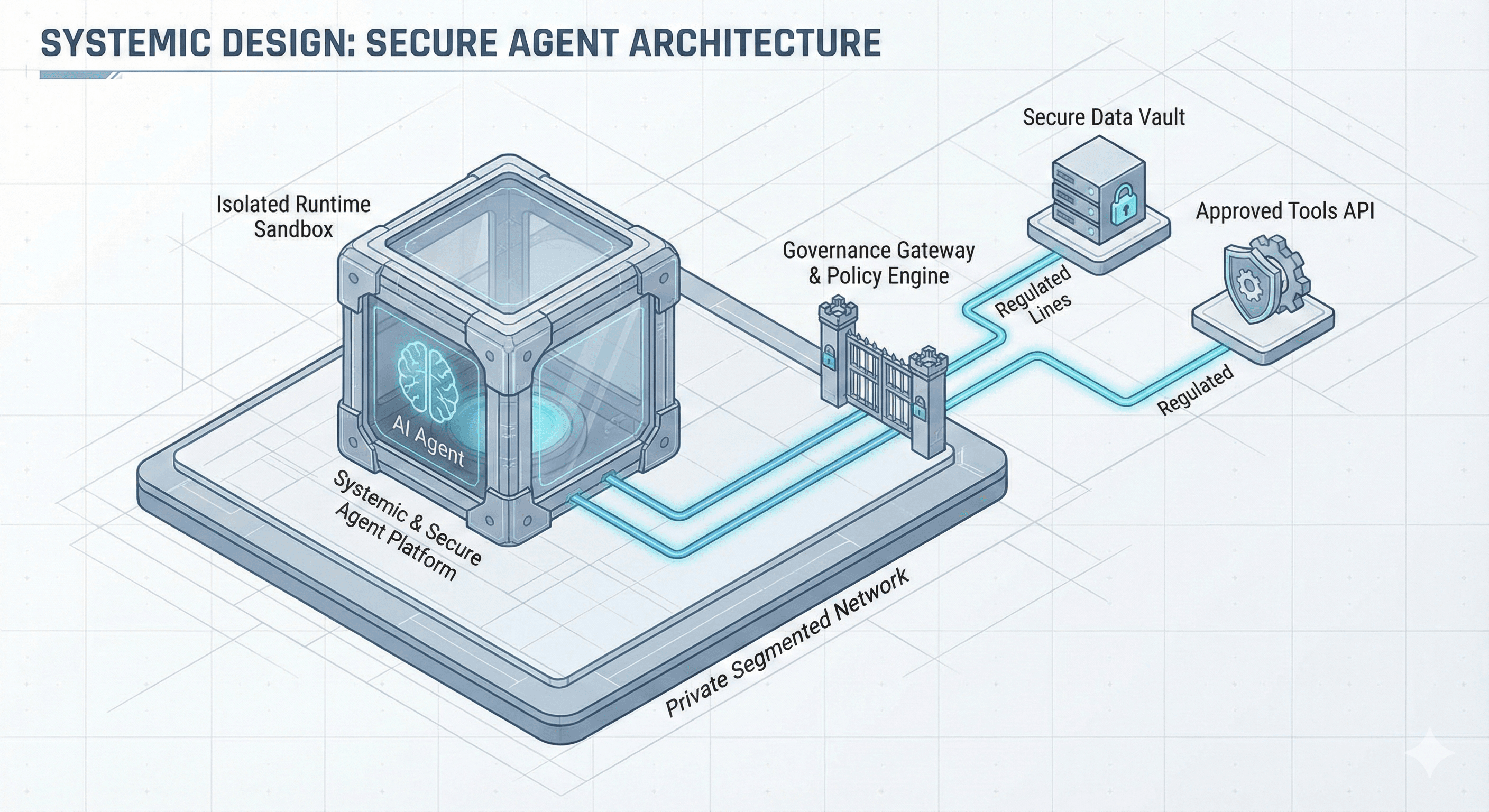
Most AI solutions require organizations to send sensitive data to external platforms, creating challenges around security, control, and compliance. This article presents an alternative approach where AI agents operate entirely within a company’s own infrastructure, enabling businesses to deploy and scale autonomous agents while maintaining full data sovereignty and governance.

While building individual AI agent prototypes is relatively easy, scaling them across an organization requires strong governance, security, observability, and centralized management. A platform-driven approach enables companies to deploy, monitor, and improve AI agents at scale, turning isolated experiments into a coordinated digital workforce.

Many companies deploy AI with inherited user access, unintentionally turning it into a super-user that can expose sensitive data through synthesis and logic errors. To scale AI safely, organizations need an agent-native architecture where each AI has its own identity, limited task-based access, and clear governance.

Agentic AI prototypes move far faster than traditional enterprise governance, exposing how legacy processes turn speed into risk when verification cannot keep up. In the AI era, organisations need to replace control-heavy planning with fast, learning-driven governance, because slowness has become the biggest risk.

Agentic AI goes beyond task automation by observing real work as it happens, revealing hidden friction, exceptions, and how organisations actually operate. Its true value unfolds in three stages: execution (efficiency), observation (intelligence), and adaptation (agility), where systems learn and evolve in real time.

It is common to confuse AI Agents with Agentic AI, but an AI Agent is simply a task-focused tool that reacts to instructions, while Agentic AI is a system-level capability that proactively pursues goals and adapts through feedback. The key difference is that agents execute actions, whereas agentic AI takes ownership of outcomes by embedding reasoning, autonomy, and workflow accountability.

Monolithic AI systems centered on a single large model don’t scale in production,they become slow, costly, and unreliable. The future is distributed, agentic architectures where specialized small models do most of the work, large models act as strategists, and modular platforms let intelligence scale outward like a digital workforce.
Enterprises are rebranding standard GenAI as “agentic AI”, but most deployments still behave like co-pilots bolted onto unchanged workflows. True agentic AI is not a label. It is an operating-model shift where digital colleagues take responsibility for outcomes, coordinate across silos, and improve through feedback. Without redesigned decision rights, governance, and learning loops, “agentic” becomes semantics and slows real transformation.

Agentic AI is not another app on the stack, it's a new nervous system plugged into data, tools, and people. This article explores how to transform AI security from a checklist into an operating model, enabling digital colleagues that are bold in the workflow and boring from a security perspective.
Learn how digital colleagues are transforming the finance department from a static report generator into an adaptive, forward-looking partner. By connecting systems in real-time, AI agents can interpret risks, automate reasoning, and give finance the momentum needed to steer the business.
Modern marketing is chaotic, with fragmented data across multiple systems. This article explains how digital colleagues (AI agents) can navigate this mess, connect disparate data sources in real time, and enable human teams to focus on creativity rather than data integration.
Agentic AI shifts business logic from rebuilding capabilities to capturing and reusing them, creating reusable intelligence that compounds over time.
This article explains why AI transformation is a compound effect, not a linear process, and argues that agent-based AI can bridge silos and unlock value through experimentation.
Most enterprises fail at AI due to process, not tech. This article introduces the "Gladiator methodology," a fast, participatory approach that moves organizations from concept to operational AI agents in weeks, building trust and momentum.
In a crisis, speculation and disinformation spread rapidly. This article explains how agentic AI can act as a force multiplier for public authorities, enabling them to quickly publish verified, multilingual information across various channels and lead the narrative instead of chasing it.
Explore how AI is evolving from simple chatbots to sophisticated digital colleagues that enhance customer service by balancing efficiency with a human touch, enabling faster, more personalized, and scalable support.
Enterprise software is shifting from a passive tool for information and collaboration to an active participant in business outcomes. This article explores the new frontiers of execution, coordination, and learning where companies can build lasting competitive advantages.
This article outlines how to secure and govern AI agents in an AI-native enterprise by extending zero-trust principles and embedding secure-by-design workflows, while emphasizing the critical role of human oversight to manage AI's inherent limitations.
Discover why individual AI tools do not automatically lead to business success and how companies can bridge the gap by integrating agent-based AI into core functions with measurable results.
This article delves into why most enterprise AI initiatives fail, arguing that the root cause is a fundamental misunderstanding of AI as a standalone technology rather than a holistic systems transformation. It provides a framework for leaders to orchestrate three simultaneous transformations technical systems, human capital, and business models.
Artificial intelligence, especially large language models, is transforming work but comes with a significant environmental cost through its carbon emissions. This article explores AI’s carbon footprint and the strategies organizations can use to reduce it, from choosing green infrastructure to optimizing agents.
The era of revolutionary leaps in AI is giving way to incremental refinements of the transformer architecture, pushing the industry toward a "local maximum." The next true breakthrough will require a departure from the current architectural blueprint and a shift toward new paradigms.
Organizations must adapt their security principles from digital systems to the physical world in order to address the new challenges posed by AI-driven devices. This requires a zero-trust architecture and clearly defined accountability.
Autonomous AI agents are the next frontier after chatbots and copilots, but most enterprise-scale deployments either stall or underperform. This article outlines the key structural, design, and governance failures that derail agentic AI projects and provides actionable fixes.
This article highlights the critical role of AI agents in transforming ESG reporting from a compliance task to a core business function. It emphasizes treating AI agents as "digital coworkers" that continuously monitor, process diverse data, and act on ESG metrics, advocating for robust governance structures to manage their performance and accountability.
This article examines how AI agents are displacing traditional entry-level roles, which historically served as career stepping stones. It proposes redesigning work around "variability" through AI-human collaboration, creating new entry points like orchestrator or auditor roles focused on contextual contribution rather than repetitive tasks, thereby fostering inclusive and resilient organizations.
This article argues that "hallucinations" in enterprise AI agents are a design problem, not a model flaw. It advocates treating AI models as "digital colleagues" that require proper onboarding, structured workflows, and robust oversight to perform reliably, emphasizing an architecture-first approach over solely focusing on model fine-tuning.
This article explores how AI agents can transform Governance, Risk, and Compliance (GRC) from a financial burden into a strategic asset. It argues that AI agents excel at the rule-bound and context-heavy nature of GRC work, enabling "active governance" and freeing human professionals for higher-value tasks, while also discussing the challenges and strategies for responsible deployment.
AI agents can revolutionize GRC (Governance, Risk, and Compliance) by automating routine tasks, improving accuracy, and transforming compliance work from a costly burden into a strategic asset. This transformation frees up experts to focus on strategic analysis and decision-making.
This article explores how traditional human performance management frameworks can be adapted to effectively manage and evaluate AI agents, or "digital colleagues," in organizations. It focuses on using concepts like performance reviews, OKRs, and incentives (without salaries) to ensure AI agents align with business goals, perform reliably, and contribute meaningfully to team outcomes.
This article examines the shift in insurance claims from straight-through processing (STP) to straight-through AI processing (STAIP), where AI agents autonomously handle claims. It discusses the benefits of speed and efficiency versus the new risks related to trust, accountability, and fairness, proposing a "minimum-touch test" and human-override design patterns to manage these digital adjusters effectively.
This article examines how AI agents are fundamentally changing the economics of scaling work by breaking the linear link between operational capacity and headcount costs. It highlights that while initial investment is required, AI agents offer near-zero marginal replication costs and dramatically lower ongoing operational expenses compared to human employees, providing significant competitive advantage.
This article introduces "Span of Responsibility" (SoR) as a key metric for measuring enterprise AI maturity, focusing on the proportion of live workflow an AI agent is trusted to handle end-to-end, beyond just its technical capability. It argues that true AI impact comes from delegating real operational ownership to digital colleagues, necessitating a new management and governance framework.
This article argues that the traditional model of buying software from single vendors is outdated for AI agents, as their value is in delivering outcomes across systems, not being tied to a platform. It advocates for a "task-first" procurement philosophy, where companies "hire" interoperable and autonomous digital colleagues based on their ability to get the job done, fostering portability and strategic flexibility.
IT leadership must evolve from managing systems to designing intelligent ecosystems. This transformation requires a redefinition of roles, from CIO to CISO, to orchestrate collaboration between humans and AI agents.
Enterprise IT is fundamentally changing as AI colleagues become part of the workforce. This article introduces a new, protocol-based architecture that enables intelligence, agility, and coordination across teams consisting of both humans and AI.
This article argues that the rapid advancement and deployment of AI agents necessitates treating them as "digital colleagues" rather than mere software, urging legal and HR departments to develop labor-law-style frameworks for their management. It emphasizes defining roles, establishing oversight, ensuring compliance, and addressing liability for AI agents operating autonomously within organizations.
AI’s ability to generate false digital evidence has broken the fundamental trust in automated systems. This forces companies to reintroduce human oversight to verify data and combat fraud.
Many companies are re-evaluating their cloud exposure. Building an in-house, or at least hybrid, AI infrastructure is a strategic task that requires careful planning and the right technology. This guide outlines how to build a future-proof AI infrastructure.
Agentic AI acts as a digital colleague, managing tasks like due diligence, financial modeling, and deal sourcing with speed and precision, freeing up deal teams to focus on strategy and negotiations. This transformation shortens deal cycles, reduces execution risks, and enhances overall investment performance.
Traditional enterprise systems are built for standardization and are not designed for today’s demands for dynamic, real-time business processes. Agentic AI, or “digital colleagues,” is revolutionizing this by creating a flexible and adaptable workforce.
Traditional enterprise software is obsolete, failing to meet the demands of modern business. This article explores how AI-driven digital colleagues, or agents, are set to replace these rigid systems, offering a more agile, adaptable, and cost-effective future for enterprise operations.
AI marketing agents are revolutionizing marketing by enabling hyper-personalized content creation and delivery. By analyzing vast amounts of data, AI helps businesses understand customer behavior and automatically generate tailored messages, boosting engagement and sales.
This article explores how AI-driven visual search is transforming e-commerce, acting as an indispensable tool for retailers. It covers the technology's core benefits, real-world applications across various industries, and provides a step-by-step guide for implementation.
This article explains why evaluating AI models requires more than just technical accuracy, emphasizing a holistic approach that aligns model performance with strategic business objectives and risk management. It highlights the importance of cross-functional collaboration to translate technical metrics into real-world value.
This article outlines the crucial shift from AI proof of concept to proof of value and sustainability. It provides a 10-step roadmap for ensuring AI initiatives deliver measurable, long-term business impact by focusing on high-value use cases.
This article explores how AI agents, acting as digital colleagues, can address the unique challenges of cold chain management by improving forecasting, enhancing visibility, and enabling autonomous decision-making to mitigate risks and reduce waste.
This article explores how artificial intelligence is transforming the energy sector, detailing specific applications in power generation and electric utilities to enhance efficiency, integrate renewables, and improve grid reliability.
This article offers a high-level explanation of how machine learning models are trained by approximating functions and minimizing loss, highlighting the critical role of data quality, quantity, and balance while covering common pitfalls like overfitting and underfitting.
The article challenges the simplified "build or buy" debate about AI, instead advocating for a modular, adaptable strategy that combines building, buying, and "borrowing" solutions to focus on high-impact use cases.