
The monolith is dead (again): why SLMs force the next architectural upgrade
Monolithic AI systems centered on a single large model don’t scale in production,they become slow, costly, and unreliable. The future is distributed, agentic architectures where specialized small models do most of the work, large models act as strategists, and modular platforms let intelligence scale outward like a digital workforce.
The monolith is dead (again): why SLMs force the next architectural upgrade
Introduction
AI systems today are built for a world with infinite patience and infinite compute. Everything flows through one giant model, one giant endpoint, one giant cognitive bottleneck. It is impressive, but physics are inevitable: centralization works until the volume arrives.
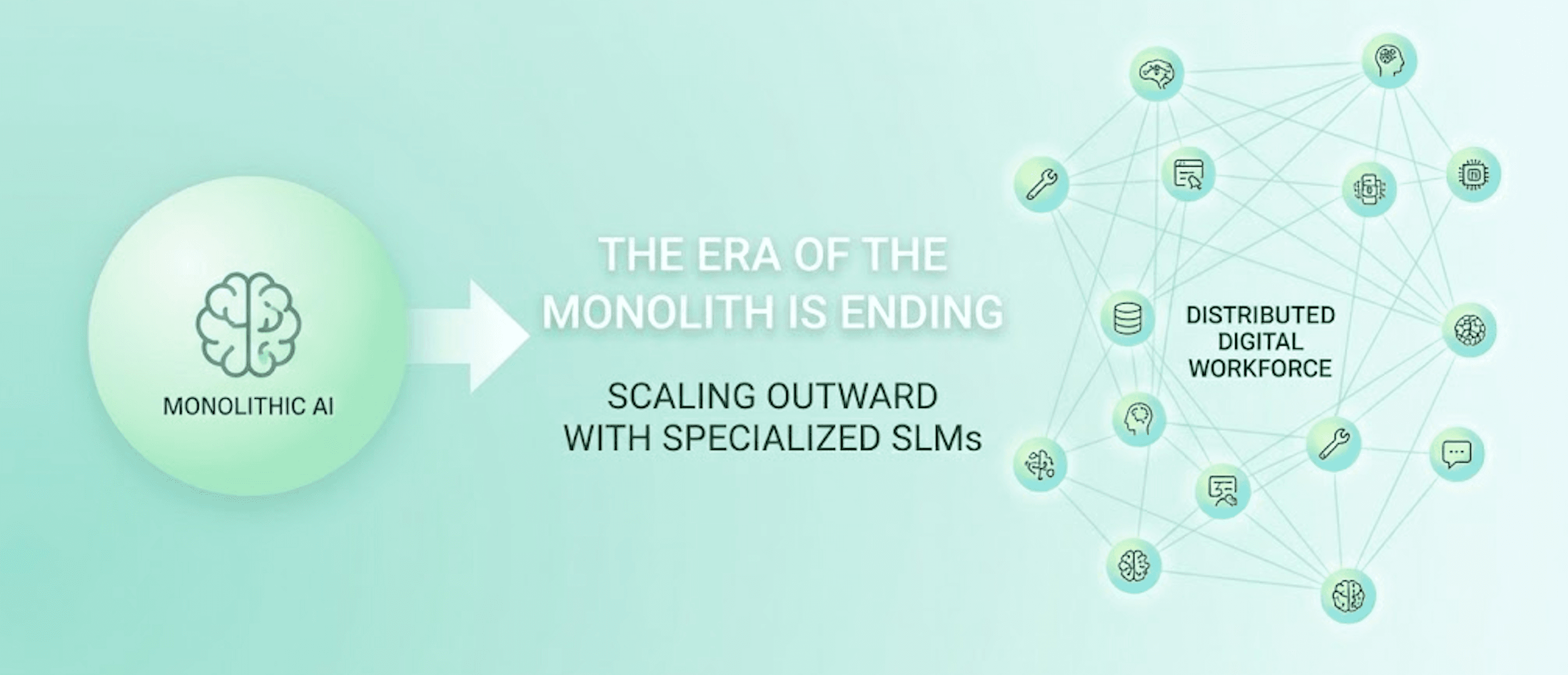
Agentic AI is already moving from a single model setup to a distributed network of specialized SLMs (and LLMs), each built to do one thing with reliability. It feels less like automation and more like an actual digital workforce. The shift is architectural. And once you see an SLM-first system outrun a monolithic agent by orders of magnitude, you realize the transformation is already here. We are no longer only scaling intelligence upward, we are starting to scale it outward.
For the deep dive on why scaling laws alone won’t deliver the next leap: Beyond the Scaling Laws: Why the Next Leap in AI Requires an Architectural Revolution
Why the old world had to break
The early agentic pattern is based on one large LLM that handles reasoning, planning, tool calling, and execution. But as soon as we push the systems, the limits become clear. Latency spikes, hallucinations, schema adherence falls apart and costs increase. A tiny formatting error in a tool call brings down entire chains.
Behind the scenes, everything depends on the same overloaded cognitive core. It performs, then slowly buckles in production, especially under high-frequency, low-latency requirements.
The legacy constraints are obvious:
- One model acting as planner, executor, and router created cascading bottlenecks.
- High latency makes real-time workflows effectively impossible.
- Unpredictable output turns tool calling into an expensive gamble.
- Serving costs rose linearly with usage, punishing success.
The monolith fails for the same reason monoliths always fail: too much intelligence/logic trapped in one place. Heterogeneous systems are not a nice-to-have, they are an engineering inevitability. And the shift forces a new approach; agentic AI architecture must be as modular as the intelligence it supports.

“ Enterprises don’t win by owning the biggest model, they win by having the platform where new agents can show up, plug in, and start delivering value by lunchtime. ”
A new cost-effective and responsive architecture
Specialized SLMs is a story about tighter design. SLMs deliver fast, deterministic, schema-perfect outputs with a computational footprint that makes them economically viable. When you can set up a model in hours and deploy it on commodity hardware, the center of gravity shifts from “how big is your model” to “how many specialized agents can your platform support”.
Distributed intelligence demands distributed infrastructure. Once you split intelligence across multiple specialized agents, the underlying platform cannot remain monolithic nor be a pre-packaged locked-in SaaS platform. Modularity is a foundation: modular routing, memory, orchestration, and monitoring. This enables the system to scale, evolve, and remain stable.
SLMs reshape the architecture because they:
- Create deterministic, structured outputs required for reliable tool chains.
- Reduce compute costs so drastically that scale becomes a design feature.
- Enable role-based division of labor across multiple agent types.
- Require platforms that can mix, match, upgrade, and recombine agents without friction.
SLMs turn AI platforms into modular ecosystems. Intelligence becomes interchangeable. Capabilities become hot-swappable. The architecture stops being a machine and starts behaving like a living system.
The hybrid model: the LLM becomes the strategist, not the system
In a distributed agentic architecture, LLM takes the role of a “strategist”. Its job is to interpret ambiguity, plan complex tasks, and intervene only when specialization runs out. Everything else flows to SLMs, which act as the operational backbone, executing predictable tasks at high volume and low cost.
This inversion only works with platform modularity. If every request must pass through a central conductor, the cost advantage of SLMs disappears. Routing must be composable. Execution must be localized. The platform must support a heterogeneous team, not a single-model dependency.
This hybrid paradigm succeeds because it:
- Routes tasks to the cheapest capable model with minimal overhead.
- Allows agent chains to grow or shrink without platform redesign.
- Supports targeted upgrades to bottleneck agents instead of entire stacks.
- Enables cost curves and capability curves to compound simultaneously.
Once the LLM becomes an on-demand specialist, not the default engine, the economics flip. Distributed intelligence only works when the platform beneath it is equally distributed. Modularity stops being an architectural preference and becomes a survival trait.
Memory, routing, and the infrastructure that turns agents into colleagues
Modern architectures externalize memory and give agents the ability to call it like a tool. Routing follows the same logic. When tasks move to the right agent automatically, the system starts behaving like a coordinated digital team rather than a sequence of prompts stitched together.
These capabilities only function in a modular platform. Memory must be a service. Routing must be a service. Context management must be a service. When each is independent, the system self-organizes and adapts. When tightly coupled, it collapses under complexity.
This foundation enables:
- External memory functions that expand SLM context infinitely.
- Specialized memory experts that maintain factual rigor.
- Parameter sharing and compression for edge-native agents.
- Sequenced multi-agent workflows that behave with industrial discipline.
A modular platform turns specialized agents into colleagues, not components. And the system compounds because each agent is both independent and interoperable.
The real advantage: why an agentic AI platform wins
Choosing an AI architecture is a decision about how your entire organization adapts, competes, and scales in a world where every process can be delegated to digital colleagues. The true leverage now is building on a platform designed for reuse, flexibility, and compounding value.
A modular agentic AI platform means every new agent inherits proven capabilities, tool integrations, and safety layers out of the box. Need to swap in a new model? It’s a configuration, not a rebuild. Want to launch a domain expert, automate a workflow, or spin up a virtual colleague in record time? The building blocks are already in place.
The future is about mixing the right models for the right jobs, switching between LLMs and SLMs, public and proprietary, cloud and edge, all within the same operating fabric. The platform does the heavy lifting: orchestrating flows, enforcing compliance, monitoring behavior, and letting new agents join with zero friction.
This is what the winning enterprises will do:
- Leverage a modular platform with reusable agent capabilities and pluggable models.
- Onboard new AI agents flexibly and safely, without endless custom dev cycles.
- Mix and match SLMs and LLMs to optimize for cost, speed, and outcome, on demand.
- Roll out business-critical agents in days, not quarters, with compliance and observability built-in.
When AI is treated as an extensible, agentic platform, not a patchwork of projects, the pace of innovation increases.