
Agentic AI: From task automation to systemic learning
Agentic AI goes beyond task automation by observing real work as it happens, revealing hidden friction, exceptions, and how organisations actually operate. Its true value unfolds in three stages: execution (efficiency), observation (intelligence), and adaptation (agility), where systems learn and evolve in real time.
Agentic AI: From task automation to systemic learning
Introduction
Most transformation projects look the same. New technology arrives, management agrees on a direction, and suddenly we are tracking progress in a spreadsheet. It looks organized, but usually, we are just digitising old ways of working. Agentic AI is different. It starts with automating tasks, but quite quickly the system begins to monitor itself. For example, instead of just handling tickets, it listens for signals across channels. Suddenly, this isn’t business as usual. The organisation starts learning in real time from every interaction.
The “old world” (can you say that?) relied on the idea of the standardized process"; a theoretical model where work flows in a straight line from start to finish, where everything could be fit into a defined way of working. We designed processes based on the "happy path," assuming that inputs would be correct, systems would stay online, and people would behave predictably.
In this model, processes were treated as fixed infrastructure. People were supposed to follow a checklist, and record the final transaction in a system, and anything that did not fit the box was labelled an "exception." But in reality, this was often the most critical part of the business. It was the tribal knowledge, the specific workaround for a difficult supplier, the quick email to fix a data error, or the manual spreadsheet kept on a desktop to track urgency (how many of these exist in your organization?). This work was never written down, yet the company relied on it to function.
Companies accept this discrepancy because there is no alternative. Legacy automation (like RPA) only touched the structured, repetitive tasks, the easy bits. We made minor optimisations to the visible workflow and tried to govern the rest with policy. The truth, however, is that the real operating model of the company lived in the gaps between the systems. It lived in chat logs, email chains, and Excel files that IT did not know existed.
This created the universal pain points we see today:
- Optimisation stalls: We try to fix the process we think we have, rather than the one that actually exists. You cannot optimise what you cannot see.
- The data disconnect: Data teams build pipelines expecting clean, structured inputs. Operations teams, facing a messy reality, are forced to "fix" data manually to make it fit, hiding the root cause of the quality issue.
- The pilot trap: Pilots often succeed in a controlled environment ("the lab"), but fail to scale because the rigid automation breaks as soon as it encounters the variability of the real business ("the wild").
- Steering blind: Leaders make strategic decisions based on reporting that only captures the "happy path," leaving them with partial and often outdated insight into operational risks.
Agentic AI can fundamentally change the dynamics of business
Agentic AI differs fundamentally from traditional automation. While standard software follows a rigid script, an agent pursues a goal. It can navigate systems, make low-level decisions, and handle the ambiguity that usually requires human intervention.
However, the impact of this technology is not binary. It unfolds in stages of maturity. We categorise this progression into three orders of effect.
Most business cases focus entirely on the first order; simple efficiency. While this delivers immediate returns, it misses the structural advantage. The true potential of Agentic AI lies in moving from simply doing the work to understanding it, and finally, to evolving the organisation based on that understanding.
At Algorithma, we categorise the value into three distinct orders. Most business cases stop at the first, but the structural advantage lies in the second and third.
- First order (Execution): The agent performs the task. The value is Efficiency.
- Second order (Observation): The agent records the reality of the process. The value is Intelligence.
- Third order (Adaptation): The agent helps the system evolve. The value is Agility.
When we deploy digital colleagues, we are not just installing a faster worker; we are installing an observer. Because the agent works inside the process, handling the emails, reading the documents, and making decisions, it captures the nuance that traditional systems miss. And unlike for humans, everything is captured digitally.
It does not just perform the task; it creates a log of the context. It records the friction, the exceptions, and the variances. The agent creates the data that finally reveals how the organisation actually moves. That is when the conversation shifts from "how do we save time" to "how does our business actually work."
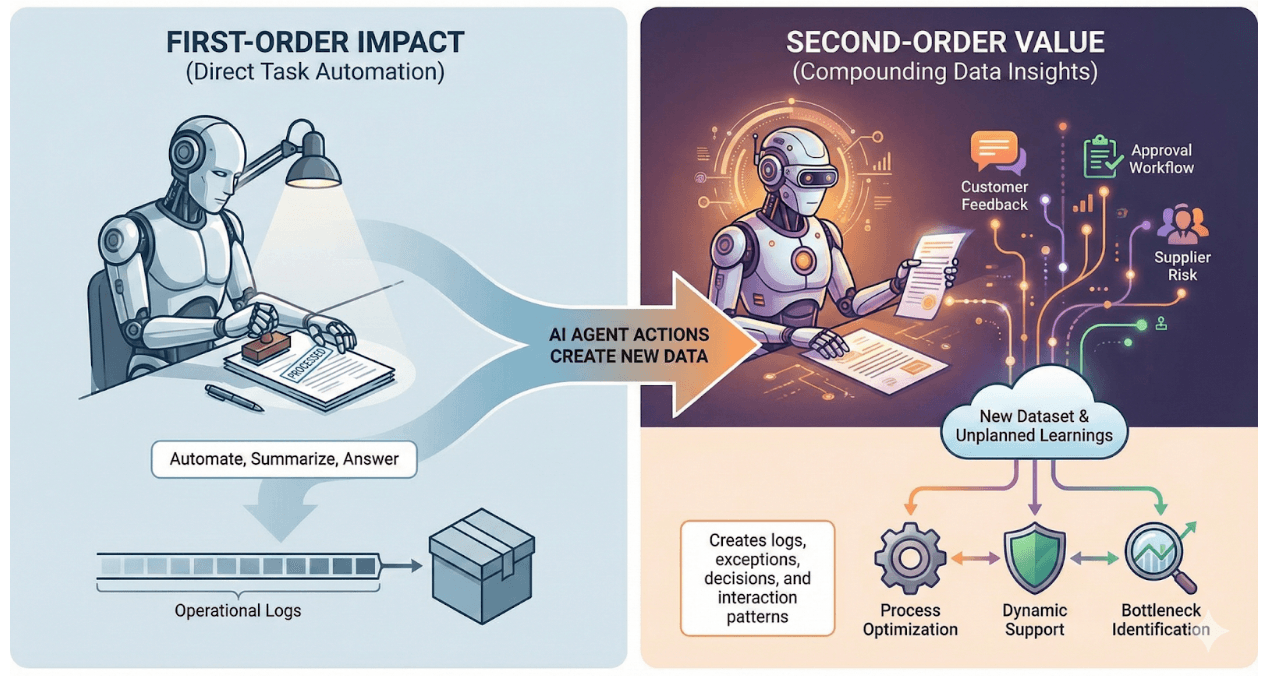
First order impact: a digital colleague that does hands-on work
First order impact is the "low-hanging fruit." It is what every agentic AI business case is built on: cost reduction and speed. In this phase, AI agents take over the administrative heavy lifting. They read inboxes, extract data from PDF invoices, classify customer tickets, and verify compliance against a checklist.
The immediate result is tangible. Workloads decrease because the "drudgery" is offloaded. Speed increases because agents do not need coffee breaks, they do not sleep, and they do not get bored by repetition.
However, we must be honest about what is happening here. This is not transformation; it is substitution. We are simply swapping a human operator for a digital one within the exact same workflow. If your current process is bureaucratic, complex, and prone to errors, the agent will simply execute that bureaucracy faster. You are not fixing anything; you are just driving faster across the hurdles. The first order impact however;
- Creates capacity: We remove low-judgement, high-volume work from human teams. This stops the "burnout" cycle, but it only adds value if those humans are then redirected to work that actually requires critical thinking.
- Reduces cycle times: Agents do not wait for meetings to make decisions. They do not queue tasks. A process that took three days because of "inbox wait time" now takes three minutes.
- Improves consistency: Humans are variable; they have good days and bad days. Agents are consistent. They apply the same logic to the first transaction as they do to the thousandth.
- Make activities measurable: Because the work is digital, it is tracked. We move from anecdotal evidence ("we feel busy") to logged timestamps.
The problem is that faster execution does not fix the company structure. If a process requires five approvals because of a policy written in 2010, the agent will dutifully chase those five approvals. It will not ask why they are needed.
First order effects provide breathing room, but they do not provide a competitive advantage. They merely allow you to run the existing race slightly faster than before.
Second order value: a digital trail of your business process
Second order value appears when you realise the agent is not just completing tasks; it is observing them. Unlike a human employee, who might skip a step or use a workaround to get the job done quickly without telling anyone, the agent follows the logic and records every deviation. It becomes a silent auditor of your operations.
This creates a new layer of intelligence. We are no longer just looking at the result (e.g., "the invoice was paid"); we are looking at the journey (e.g., "the invoice was rejected three times due to bad data, waited 48 hours for a manager who was on holiday, and required two emails to clarify the cost centre").
Every organisation has a "shadow process"; the unwritten reality of how things actually get done, as opposed to how the procedure manual says they should be done. Humans compensate for broken systems naturally. They fix typos, they know which manager to bypass, and they know which fields to ignore.
Agents expose this. Because they generate (meta)data for every interaction, the reality becomes visible.
- Create a behavioural dataset: We move beyond static transaction data. We start seeing behavioural patterns; how teams interact, how suppliers respond, and how decisions drift over time.
- Identify actual friction: We can pinpoint exactly where value is leaked. Is it a specific vendor? A confusing policy? A software interface that confuses the user? The agent’s logs highlight the friction points without bias, with a full digital trail.
- Connect patterns between teams: Silos often hide inefficiencies because no one sees the full picture. Agents, working across these silos, reveal how a delay in procurement causes a crisis in logistics three weeks later.
- Base improvements on facts, not assumptions: Management meetings often rely on anecdotes or "loudest voice" complaints. Second order value replaces this with evidence. We stop guessing why things are slow; we have the timestamps.
This is where the value compounds. We stop trying to manage the individual tasks and start managing the system itself. One client noted: "We finally saw the things everyone already knew were broken but could never prove." The dataset changes the conversation from "work harder" to "work differently."
Read more on the compound effects here: The compound effect of AI transformation
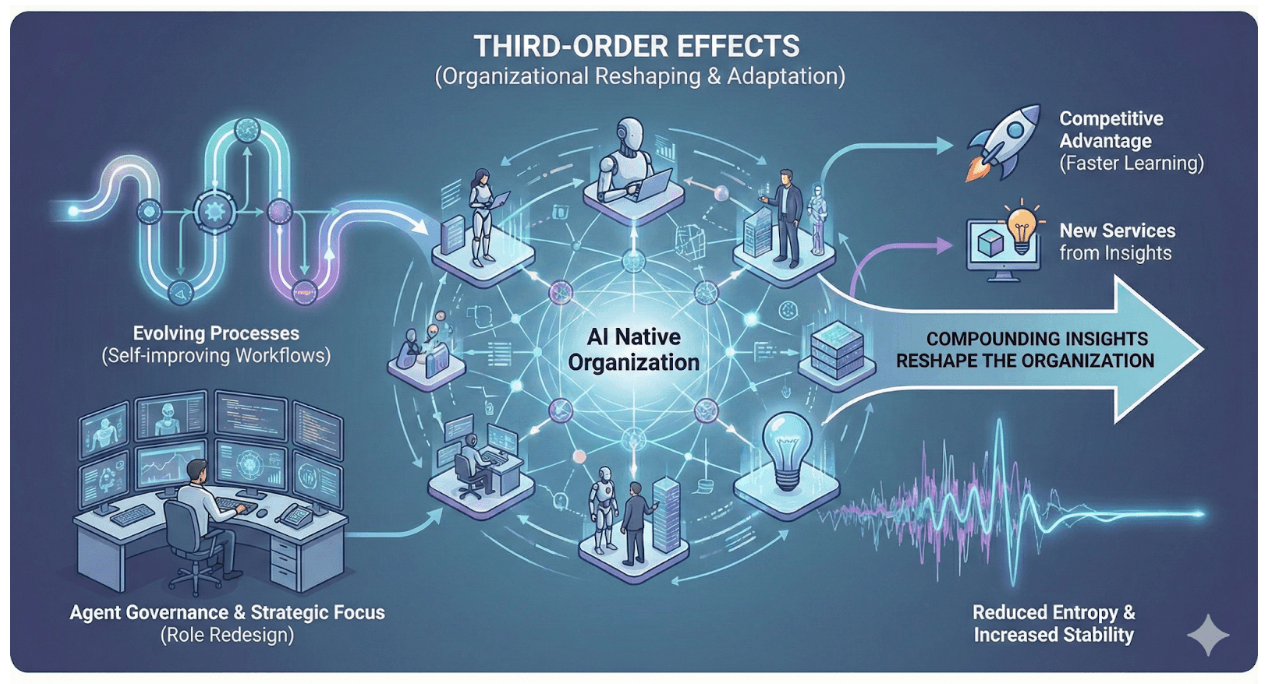
Third order effects: an emergent operating model
Third order effects represent the shift where the structure of the business begins to change. In the previous stages, we used digital colleagues to fix existing processes. Now, digital colleagues become part of the team, and the system begins to adapt based on what they find.
This is the end of the "static flowchart." In a traditional model, a process is designed once and revisited perhaps once a year. In a third-order system, the workflow is fluid. If an agent detects that a specific type of invoice carries high risk, it automatically routes it for human review. If it detects a low-risk pattern, it fast-tracks the approval.
Read what it might mean for Enterprise software here: Enterprise software is dead
This approach comes with a change in governance. Historically, governance was about control, policing every step to ensure compliance. With Agentic AI, governance becomes about guidance. We set the parameters (the "guardrails") and allow the agents to operate within them.
- Workflows tune themselves: The process does not wait for a consultant to redesign it. It could be adjusted in real-time based on the friction it encounters (get in touch and we will show you a couple of real examples)
- Decisions become stable: Because the logic is codified and consistent, decision-making becomes predictable, removing the noise of human variability.
- The system learns from every interaction: Every exception handled by a human is recorded and used to retrain the agent. The system gets smarter with every error.
- Insights turn into new ways of working: We stop fitting the business to the software and start fitting the software to the business.
This is the definition of being AI-native: when the company learns from its own behaviour, the advantage becomes part of the system.

“ We thought automation would make support faster. Instead, it showed us everything in the business that actually needed fixing. Not flashy, but extremely useful. ”
What companies should do now
Do not treat AI simply as a savings calculator. If you focus only on headcount reduction, you miss the compound value.
Crucially, you should try to avoid the "clean data" paralysis. Many organisations stall because they believe they need perfect historical data before they can start. They spend years trying to fix the past. You should aim to rebalance this effort.
Instead of only cleaning old data or fixing legacy data flows, use AI agents to create new data. Because agents operate digitally and consistently, they generate clean, structured data from day one. They do not just consume information; they fix the data quality problem as they work.
We suggest four specific actions to manage this shift:
- Just start the journey: Do not over-analyse the business case. A digital - colleague, simply by doing the work, will generate data. This data inevitably creates the insights you are missing today. The act of deployment is what reveals the opportunity.
- Architect your agentic AI platform: You cannot manage a hybrid workforce with spreadsheets. You must architect a platform that allows you to track your agents, monitor their performance, and, crucially, secure the data they generate. Governance must be built in, not added later.
- Help leaders "recruit" digital colleagues: Stop treating this as IT procurement. Help your business leaders view this as hiring. They need to define the role, the responsibilities, and the targets for their digital colleagues, just as they would for a new human team member.
- Reskill your human team: As tasks shift to agents, the human role changes. You must reskill your people to operate in a hybrid team. They are no longer processors; they must become orchestrators (managing the workflow), innovators (improving the system), and guardians (handling the edge cases and ethics).
This is the shift from theory to reality. Algorithma supports this transition through AI inception (finding the right problems), Agent delivery (building the workforce), AI agent management (managing the governance), and AI agents as a service.