
The "inherited access" trap: why your AI strategy needs an architectural pivot
Many companies deploy AI with inherited user access, unintentionally turning it into a super-user that can expose sensitive data through synthesis and logic errors. To scale AI safely, organizations need an agent-native architecture where each AI has its own identity, limited task-based access, and clear governance.
The "inherited access" trap: why your AI strategy needs an architectural pivot
Introduction
The rapid integration of generative AI into the enterprise ecosystem has fundamentally altered the landscape of data governance. While the productivity gains of LLMs are substantial, recent security incidents, such as the early 2026 vulnerability in Microsoft 365 Copilot CW1226324; serve as a poignant reminder that the underlying architecture of these systems remains inherently fragile.
The incident, where an AI assistant summarized emails protected by confidentiality labels despite Data Loss Prevention (DLP) policies, is a systemic warning signal regarding the architectural pattern of "inherited access at scale", a model that increasingly strains traditional security boundaries.

“ You cannot scale agents on top of a feature-based security model. If you want a digital workforce, you need a platform that governs identity, mandate, and autonomy from day one. ”
The problem: from passive viewing to active synthesis
In traditional security models, access is a passive right, an employee has permission to view a file. AI transforms this into active synthesis, where the system can summarize and cross-reference multiple sensitive sources at machine speed.
Many AI deployments treat the model as "intelligent software", granting it broad, persistent, and inherited access to the user's entire data landscape. This creates an inference blind spot:
- Permission inheritance: The AI operates using the user’s existing security tokens, effectively becoming a "super-user" version of the employee.
- Data in inference: Traditional DLP systems were designed for data "at rest" or "in motion", not for data being synthesized by an AI during a live chat.
- Logic errors: When policy enforcement relies on client-side filters, server-side inference logic can inadvertently bypass these protections, exposing "highly restricted" content.
A new approach: AI as a digital colleague
To move beyond AI features that increase operational risk, enterprises must adopt a platform thinking, incl. a new paradigm of digital colleagues, where AI is treated as a distinct entity governed by explicit mandates and need-to-know principles.
| Feature | AI as intelligent software | AI as digital colleague |
|---|---|---|
| Access logic | Persistent/Inherited | Explicit/Task-level |
| Identity model | Shared service principal | Unique workload identity (Agent registry) |
| Risk surface | Entire accessible estate | Task-specific sandbox |
| Autonomy | Unmanaged/implicit | Bounded/reviewed |
A new framework for AI trust
The fundamental flaw in the current enterprise AI model is the assumption that AI should be a mirror of the user. We treat AI as intelligent software that inherits every right, token, and access point the human employee possesses. This creates a massive risk surface: if the AI has a logic error, as seen in recent leaks involving sensitive Outlook folders, it effectively becomes a super-user capable of bypassing DLP through server-side synthesis.
To scale safely, we must move from least privilege (restricting what a user can see) to least agency (restricting what an agent is allowed to do).
In an "agent-native" architecture, the AI is no longer a transparent overlay on a user’s account. It is treated as a digital team member, i.e. a distinct entity with its own identity and workload boundaries.
- Explicit invocation over persistent access: A digital colleague does not sit in the background indexing your entire estate. It is granted access to specific data sources only when explicitly called for a defined task.
- The agent registry: Rather than using shared service principals, every agent is assigned a unique identity in a centralized registry. This allows security teams to map "vendor agent IDs" to internal enterprise identifiers for clear ownership and lifecycle control.
- Managed autonomy levels: We no longer grant "blanket" autonomy. Instead, we define explicit readiness gates, ranging from "Recommendation only" to "Execution with pre-approval", matched to the criticality of the business process.
A digital colleague must also be auditable in a way that standard software is not. This is achieved through:
- Sessions: Grouping interactions into a single thread to ensure multi-agent attribution.
- Traces: Maintaining an immutable trail of the agent’s internal logic, i.e. recording the Thought -> Tool Call -> Observation -> Response chain. This provides the "meaningful review" required by regulations like GDPR, allowing humans to contest or verify why specific data was used in a synthesis.
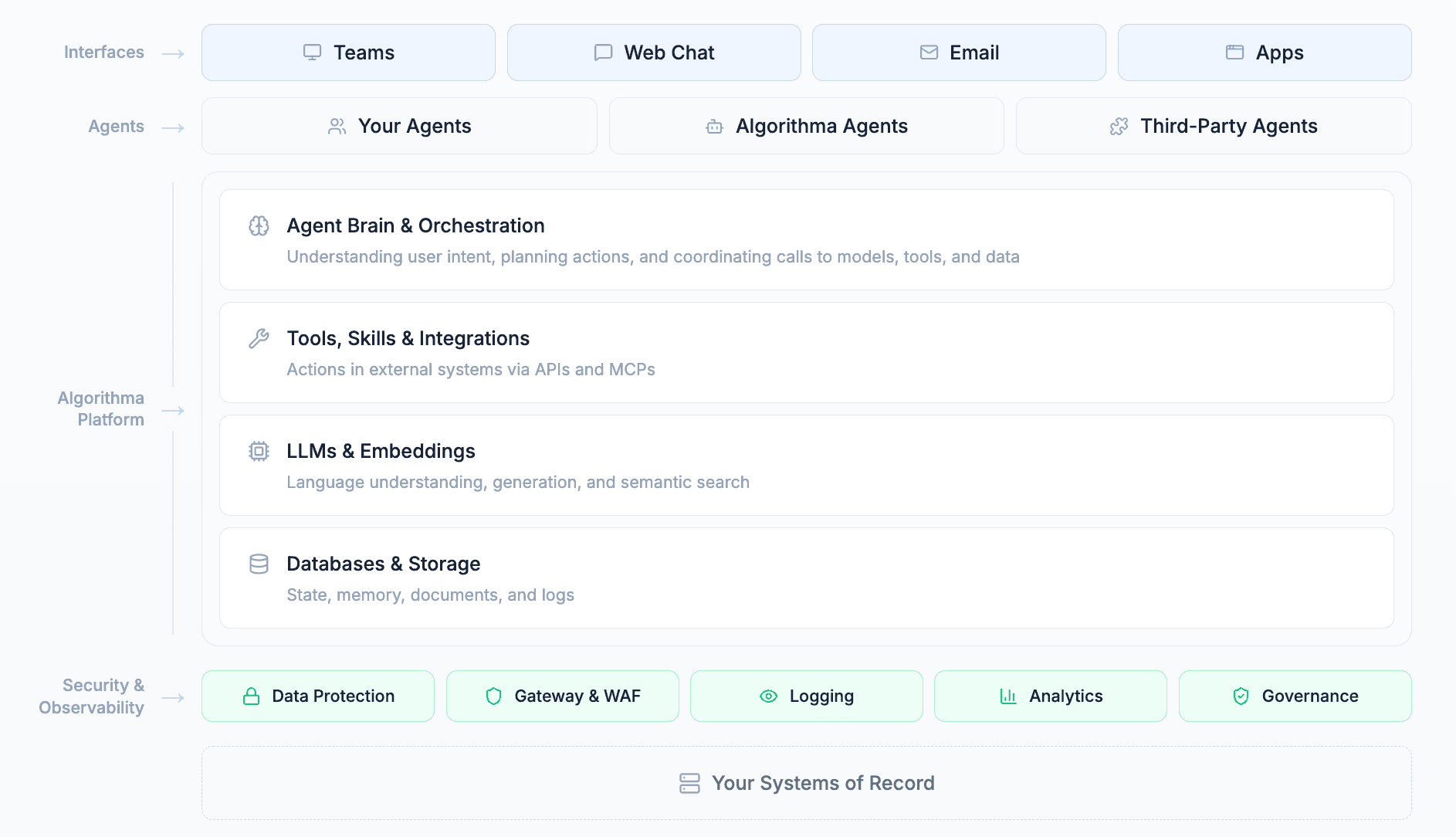
Executive strategy: the agent factory mindset
For CIOs and CISOs, the transition to a managed digital workforce involves three core pillars:
- Unified management: Centralize oversight of all agents in an agent registry to normalize identities across different vendor runtimes.
- The agent factory: Implement reusable guardrails, such as "Prompt Shields" and "Inference Gating," rather than hand-crafting security for every new tool.
- Managed autonomy: Define explicit autonomy levels, e.g. from "recommendation only" to "execution with pre-approval", to match the criticality of the task.
The era of "passive AI" is ending. We are entering the agentic era, where AI acts with increasing independence. Organizations that continue to rely on "inherited access" will find themselves managing a constant stream of logic-error vulnerabilities. The future lies in building a reliable, auditable, and scalable digital workforce through rigorous platform governance.
Before scaling AI, every CIO and CISO should be able to answer three questions:
- Can we list every AI agent operating in our environment?
- Does each agent have its own identity and bounded mandate?
- Can we explain why an agent used a specific document in a specific session?
If the answer to any of these is no, the problem is not the model. The problem is the architecture.
Read more on Algorithma’s agentic AI platform here.