Elevate Agentic AI from novelty to critical infrastructure
Agentic AI is not another app on the stack, it's a new nervous system plugged into data, tools, and people. This article explores how to transform AI security from a checklist into an operating model, enabling digital colleagues that are bold in the workflow and boring from a security perspective.
Elevate Agentic AI from novelty to critical infrastructure
Introduction
Agentic AI is not another app on the stack, it is a new nervous system plugged into data, tools, and people. That nervous system can learn, act, coordinate, and occasionally hallucinate with conviction. Which is powerful, and slightly terrifying.
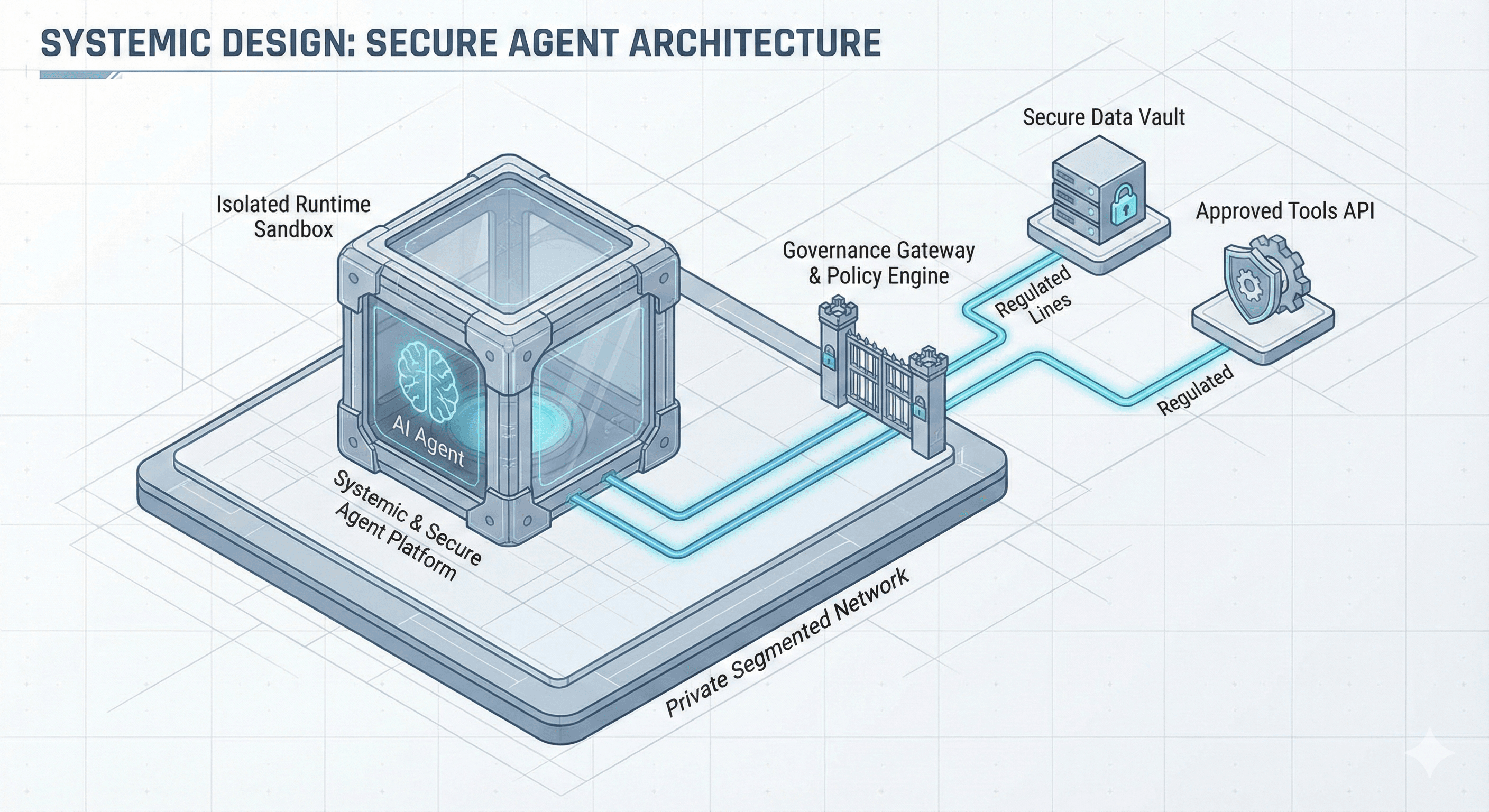
This is the moment where security stops being a checklist and becomes part of the operating model itself. A proper agent platform gives digital colleagues a secure work environment of their own, with segmented networks, isolated runtimes, controlled ingress, private service access, and zero chance of wandering around the internet with a backpack full of tokens. The goal is simple: agents that are bold in the workflow and boring from a security perspective. That is exactly the point.
Replace ad-hoc security with systemic design
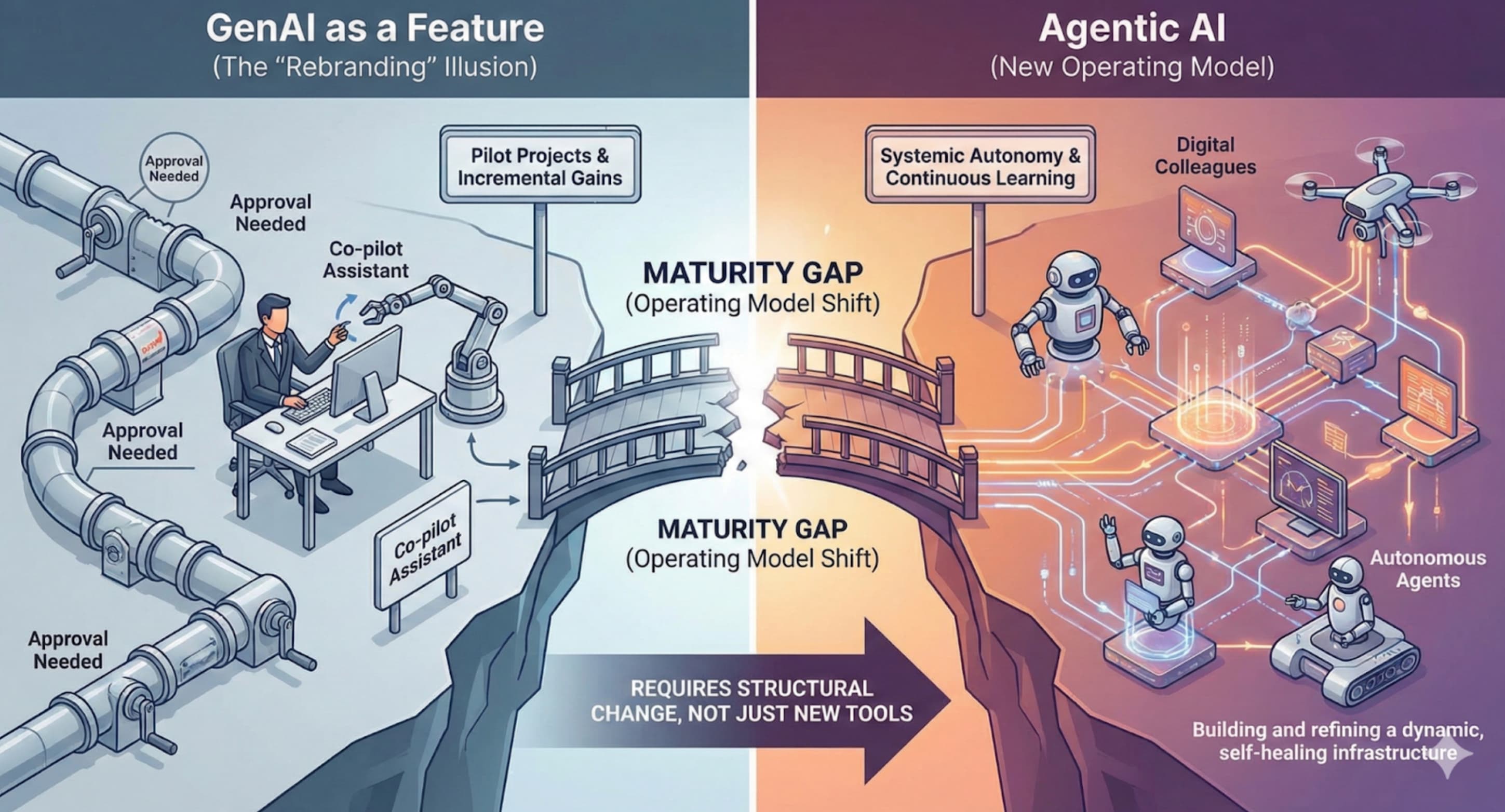
In the old world, security and innovation were in constant couples therapy. Engineering teams opened things up, security teams closed them down, and AI arrived like an over-excited intern with access to everything. Most organisations layer "AI features" onto existing applications, keep the data plane as-is, and hope the model's system prompt would behave like a firewall. Spoiler: it does not.
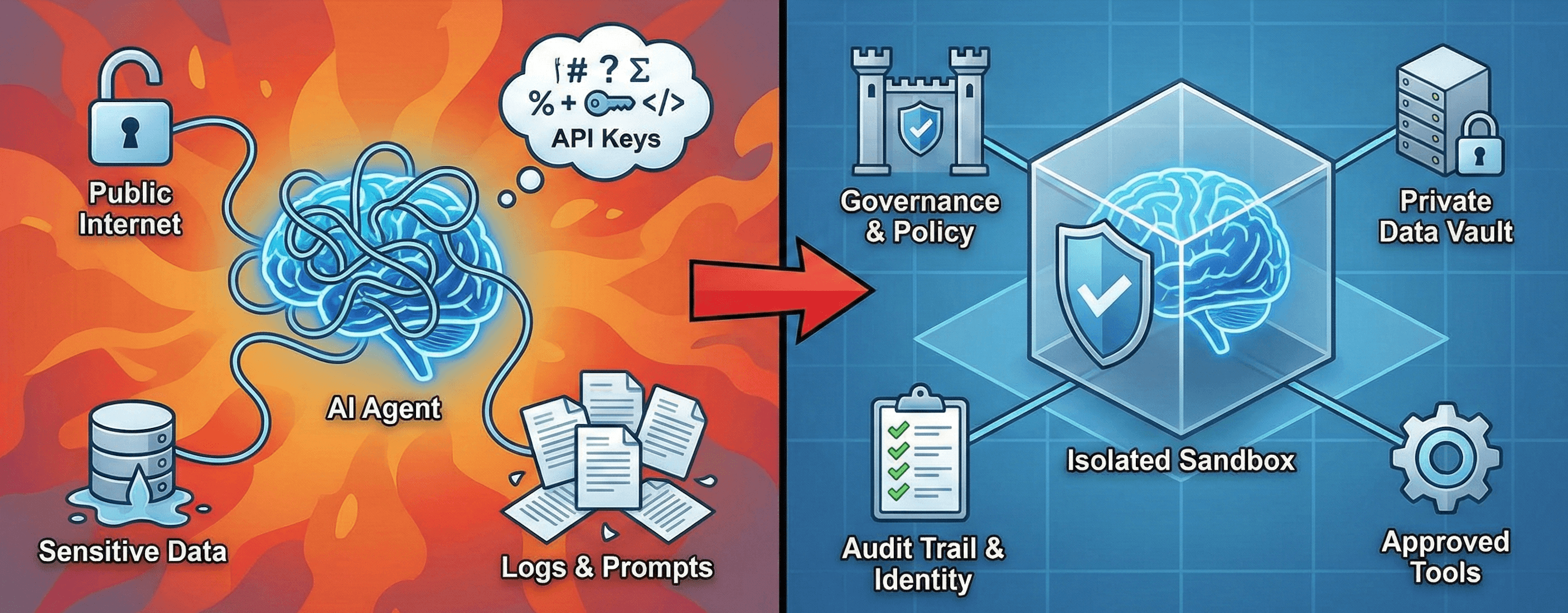
The reality is messy. LLMs call tools, tools call APIs, APIs talk to legacy systems, and nobody can quite explain which agent can touch what. Meanwhile, prompts, logs, and embeddings quietly accumulate sensitive data in places no traditional governance ever imagined. Our job is to turn that chaos into clarity and show how digital colleagues add value without adding risk.
Today's friction usually sounds like this: creating agents then realising nobody modelled their permissions; connecting tools then discovering API keys living inside prompts and logs; rolling out RAG then finding embeddings that ignore tenant boundaries; talking governance but lacking any shared map of AI risks and controls.
The turning point is simple: treat agentic AI as a new work model, and treat security as a design decision, not an afterthought. Many organisations spend two years cleaning data only to watch a first agent ignore half their guardrails in three weeks.
Operationalise security through architecture
AI architecture diagrams look great in board packs and do very little for your CISO. A real agent platform is deliberately boring in all the right places. It starts with a private, segmented network envelope. It continues with isolated execution environments for observers, planners, and tool-using agents. It enforces controlled ingress through a single gateway. It routes everything else through private service connectors, not public endpoints. It keeps sensitive stores in unreachable zones with no public exposure. Every part of the environment is reachable only through explicit policies.
Digital colleagues should feel powerful to users and harmless to attackers. Channels like chat, email, workflow platforms, and IT systems connect at the edge, not straight into internal services. Identity is centralised, service credentials are scoped tightly, and monitoring flows into unified observability rather than a scattering of logs that nobody reads.
This platform shift enables you to create a single controlled entry point instead of random exposed APIs, connect agents to data only through private policy-governed paths, reduce "blast radius" by isolating agent runtimes and storage layers, and enable consistent monitoring and incident response across the whole agent ecosystem.
This means every new agent inherits a hardened environment by default, and security becomes a structural advantage. Momentum replaces the exception process, which everyone secretly prefers. Architecture becomes an engine for trust. Not a slide, not a concept, but the operating fabric that lets digital colleagues do real work without creating real nightmares.

“ There is a misconception that security slows down AI adoption. The opposite is true. When you build a platform where the infrastructure is deliberately 'boring' segmented networks, isolated runtimes, strict governance, you create the safety net that allows the agents themselves to be bold. We don't restrict digital colleagues to hold them back; we secure their environment so we can finally let them loose. ”
Quantify risk with actionable security controls
LLM risk is easy to philosophise about and harder to operationalise. We prefer numbers. Against modern risk frameworks like the OWASP Top 10 for Large Language Models, a mature agent platform can achieve significant prevention coverage across prompt injection, sensitive information disclosure, unsafe outputs, excessive agency, vector-store risks, misinformation, and runaway consumption.
The controls constrain model behaviour, enforce structured outputs, validate responses before acting, protect sensitive inputs, and treat the model as an untrusted user, not a privileged component. Guardrails live outside the model prompts should never have to pretend to be firewalls.
This looks like constraining roles and outputs then validating structured results before execution, connecting agents to tools with minimal short-lived permissions instead of master keys, enforcing access control on retrieval so RAG reflects user permissions not model optimism, and requiring human approval for irreversible financial or high-impact actions.
The payoff is trust, where each new workflow inherits the same baseline protections. Once risk becomes measurable and repeatable, innovation and compliance finally end up on the same side of the table. Everyone breathes easier, and agents move faster.
Govern model context protocols as critical infrastructure
Agentic AI is shifting from standalone models to ecosystems where agents, tools, and data sources communicate through protocols like the Model Context Protocol. This is excellent for flexibility and catastrophic if implemented like another integration bus. Context is the new control plane, and treating it casually is how organisations accidentally create a parallel shadow-IT universe made entirely of agents.
Mature platforms treat MCP-style protocols as production infrastructure: no hard-coded secrets, short-lived access tokens, least-privilege scopes for every tool, and complete audit trails of tool calls, context mutations, and agent actions. Anything vague, unlogged, or overly permissive is treated as an unmanaged attack surface.
What makes this safe instead of spooky: creating strong authentication and fine-grained authorisation for each tool and agent, connecting every deployment to central inventory observation and governance, reducing context leakage through tenant-specific scoping of prompts results and embeddings, and enabling immutable audit trails that cover every decision and every tool call.
Through governed context, cross-agent collaboration becomes safer. And the moment you govern context, you create the foundation for a genuine digital workforce.
Embed security by design so agents can earn responsibility
Security for agentic AI cannot be bolted on. It must live in the pipelines, the data flows, and the operational rhythms. A well-designed platform treats datasets as versioned assets, validates all inputs, checks lineage, detects poisoning, grounds retrieval in trusted sources, applies rate limits, sandboxes executions, filters glitch tokens, and governs models and tools like production infrastructure.
This is not glamorous, but it is what turns agents from cute demos into operational colleagues. Security becomes the runway, not the speed bump. Each improvement increases organisational confidence, which increases the scope of tasks agents can take on. Over time, responsibility compounds.
Practically this means enforcing limits, quotas, timeouts, and graceful fallbacks from day one; sandboxing network and system access so the model never becomes a lateral-movement engine; maintaining central inventories for models, tools, data, and policies; and training users so they understand both the power and the boundaries of digital colleagues.
A disciplined platform does not restrict agents, it graduates them. Responsibility scales because trust scales.
What enterprises should do now
Stop treating AI like an experiment that accidentally wandered into production. Every digital colleague you deploy is part of your operating model. If that operating model is not designed for secure agentic work, you are giving superpowers to whoever writes the most persuasive prompt.
The next move is to build a secure work environment for digital colleagues, just as you built offices, networks, and identity systems for human workers. A proper agent platform gives you a controlled environment where agents can learn, act, coordinate, and improve, all without compromising the enterprise. Once that foundation exists, use cases accelerate naturally.
To get there: build a private segmented environment specifically for agentic work, establish uniform guardrails for models, tools, data, and context, centralise identity, observability, and governance around the agent ecosystem, and treat digital colleagues as a new workforce not a scattered set of scripts.
Conclusion
This is exactly where Algorithma comes in: AI inception to shape the foundation, AI agent delivery to build on it, AI sustainment to keep it safe and evolving, and AI agents as a service when you want capability without the overhead. Once agents share what they learn safely, the roadmap writes itself. Our job is to make sure security is holding the pen.