
The cost of AI lock-in: How single-provider dependence drains enterprise budgets, and how to break free
Relying on a single AI or cloud provider creates hidden costs, inefficiencies, and strategic risks while limiting flexibility, innovation, and compliance readiness. Using a multi-provider, agent-native architecture with open standards helps organizations reduce waste, avoid lock-in, and maintain control, turning AI into a more scalable and future-proof advantage.
The cost of AI lock-in: How single-provider dependence drains enterprise budgets, and how to break free
Introduction
Artificial intelligence is supposed to make businesses more efficient, but many companies end up paying more than they should because they rely too much on a single cloud or AI provider. This dependence creates hidden costs that add up over time, not just in higher bills but also in lost flexibility and control.
Research from Gartner and IDC shows that companies using only one AI provider often face much higher operational expenses due to inefficiencies like redundant prompts, unused tool calls, and skill erosion. For example, Gartner also warns that for every AI tool organizations buy, they should anticipate at least 10 hidden costs, including transition and training expenses, which can drive up spending by 20 to 40 percent compared to multi-vendor approaches.
A significant portion of these extra costs comes from inefficient use of resources. AI workloads in single-provider environments suffer from token waste, where spending goes toward unnecessary metadata or repeated processes instead of actual results. Moving data between systems can also become expensive, with egress fees adding tens of thousands of dollars per year for large datasets. For instance, moving 50 TB of data monthly, a standard volume for AI development, can cost over 50 kUSD annually at rates of 0,09 to 0,12 USD per GB, according to Akave Cloud.
The problem isn’t just about money. Companies locked into one provider also face risks from changing regulations and geopolitical shifts. When Italy temporarily restricted the use of a major AI model in 2023, businesses that depended on it had to scramble, while those with flexible systems could adapt without disruption. The EU AI Act (Note: implementation of AI act has been postponed to Dec 2, 2027) adds another layer of risk, for non-compliance, especially when companies can’t explain how their AI systems make decisions.
Supply chain issues, such as the DRAM shortages in 2023 and 2024, have also driven up cloud computing costs by 5 to 10 %, according to McKinsey and TrendForce. These unexpected price increases make it even harder for companies to plan their budgets.
The solution isn’t to avoid AI or move everything back to on-site servers. Instead, companies can design their AI systems to be more flexible, using open standards and multiple providers. By avoiding lock-in, companies not only save money but also gain the ability to adapt to new regulations, market changes, and technological advances.

“ One of the biggest risks in AI implementations is the illusion of efficiency. When companies chain themselves to a single provider, they’re not just paying for AI; they’re paying for inflexibility, compliance blind spots, and a future they can’t control. At Algorithma, we’ve seen enterprises waste their AI spend on redundant tokens, egress fees, and vendor-imposed inefficiencies, costs that disappear the moment you design for sovereignty. True AI efficiency isn’t about locking in; it’s about the freedom to adapt, comply, and innovate without permission. ”
The research: Why lock-in is a structural problem
Single-provider AI stacks embed structural risks. At the heart of the issue is dependency: when companies build their AI systems around a single vendor’s tools, APIs, or infrastructure, they cede control over costs, compliance, and adaptability. Gartner’s 2025 research found that over 40 percent of agentic AI projects fail due to escalating costs, unclear business value, or inadequate risk controls. Proprietary ecosystems often obscure the true cost of scaling, leaving companies trapped in pricing models that become unsustainable as demand grows.
The financial burden of inflexibility starts with token waste. Enterprises using closed AI platforms overspend by up to 30 percent on infrastructure because they lack the ability to optimize token usage across different models or providers. A workflow might call the same proprietary API repeatedly, even when cheaper or more specialized alternatives exist, simply because the system is designed to favor the vendor’s own tools. Compounding this are egress and migration fees, which can cost five to six times more than storing the data itself. A 2024 Backblaze survey revealed that 55 percent of IT leaders now cite egress fees as the biggest barrier to switching providers, with some organizations paying over 2 500 EUR per model training cycle just to move their own data. Meanwhile, cloud providers frequently adjust pricing for compute, storage, and AI services, and McKinsey projects that AI infrastructure costs could triple by 2030 due to surging demand and persistent supply chain constraints. Companies locked into single-provider contracts have little room to negotiate, leaving them vulnerable to sudden price hikes.
Beyond cost, lock-in creates a compliance and sovereignty trap. Regulations and data localization laws require enterprises to document where and how their AI systems process data. Single-provider stacks make this nearly impossible. If a vendor’s model violates regulations, such as by using prohibited data sources or failing to explain decision-making, the enterprise, not the provider, faces the consequences. Under the EU AI Act’s Article 99, fines can reach 35 MEUR or 7 % of global revenue for non-compliance.
Geopolitical fragmentation adds another layer of risk. When governments restrict cross-border data flows, as seen with Italy’s 2023 ban on ChatGPT or the broader US-China tech decoupling, companies dependent on a single provider’s global infrastructure must either accept service disruptions or undertake expensive, last-minute migrations. IDC’s 2025 data shows that 45 percent of organizations have already repatriated workloads to avoid these scenarios.
Perhaps most damaging is the increase in cost of innovation due to lock-in. Gartner’s 2026 analysis warns that half of today’s agency AI platforms will become obsolete by 2029 because they can’t integrate new models or adapt to open standards. Companies using proprietary systems miss out on the ability to swap in best-of-breed tools, like Mistral for multilingual tasks or Llama for cost efficiency, without rewriting their entire stack. They also fall victim to “agent washing,” where vendors rebrand old tools as AI without delivering real capabilities. Gartner estimates that only about 130 of the thousands of so-called “agentic AI” vendors actually offer genuine multi-agent orchestration. In contrast, enterprises using interoperable architectures can reduce time-to-market for new features by 35 percent, simply by avoiding proprietary constraints.
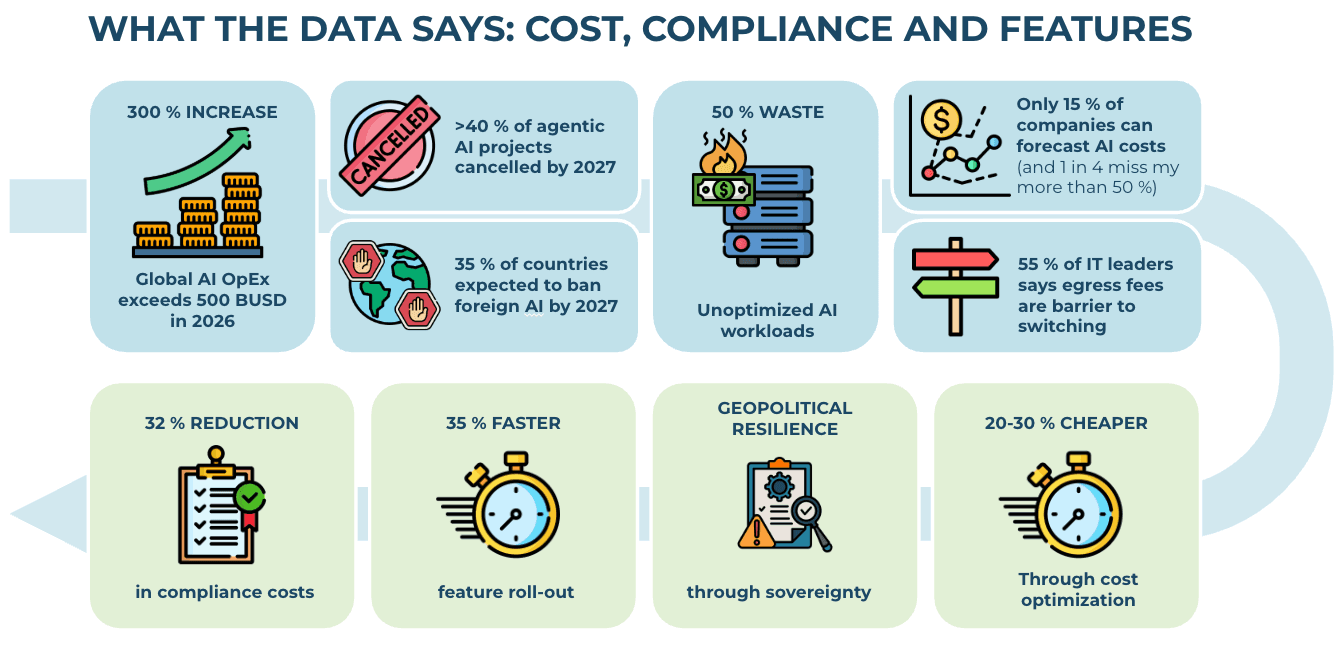
The data points to a clear solution: designing for sovereignty. Decoupling storage, compute, and AI layers can cut costs by up to 80 percent while improving compliance and flexibility. Open standards, such as OpenTelemetry for observability and MCP for agent communication, ensure systems remain portable across vendors, while management suites provide real-time visibility into token usage, egress fees, and model performance, giving enterprises the data they need to identify waste and renegotiate contracts on stronger terms.
The solution: designing for sovereignty with agent-native platforms
The answer to lock-in is to adopt agent-native platforms that prioritize interoperability, cost transparency, and portability by design. These platforms decouple AI workloads from proprietary infrastructure, allowing enterprises to mix and match models, tools, and providers without rewriting their entire stack. Research shows that companies using multi-cloud approaches experience 30 to 40 percent less unplanned downtime and can roll out new features 35 percent faster than those tied to single-provider ecosystems.
Real-time visibility and cost optimization
Agent-native platforms provide granular tracking of token usage, model performance, and egress fees, metrics that are often obscured in closed systems. For example, observability tools enable teams to attribute costs to specific workflows, helping identify inefficiencies such as redundant API calls, underutilized hardware, or suboptimal resource allocation. Industry studies show that typical AI workflows spend 30% to 50% of their runtime in CPU-only stages, meaning expensive accelerators like GPUs are left idle, leading to significant waste. By optimizing infrastructure and workflows, enterprises can achieve 20–30% annual efficiency gains through software improvements and better resources..
Platforms with immutable execution trails also support precise audits, a critical requirement under regulations like the EU AI Act, where fines for non-compliance can reach 7% of global revenue or 35 MEUR, whichever is the highest. These capabilities help organizations reduce overall infrastructure waste, improve cost visibility, and ensure compliance with evolving regulatory demands.
Portability through open standards
Agent-native architectures rely on open protocols such as the Model Context Protocol (MCP), and Agent2Agent to ensure workloads can move seamlessly across clouds, data centers, or edge environments. This approach helps enterprises avoid the "egress fee trap," where major cloud providers charge 5 to 6 times more to move data out than to store it. By standardizing agent communication, companies gain the flexibility to:
-
Swap in best-of-breed models (e.g., Mistral for multilingual tasks, Llama for cost efficiency) without vendor lock-in, as demonstrated by the growing adoption of MCP, which now supports over 10 000 active servers globally and is backed by industry leaders like OpenAI, Google, and Microsoft.
-
Comply with data sovereignty laws by deploying agents in jurisdiction-specific environments, a critical capability as regulations like the EU AI Act and U.S. Executive Order on AI impose strict data localization requirements.
-
Future-proof their systems against geopolitical fragmentation, such as Italy’s 2023 temporary restrictions on AI tools or the ongoing US-China tech decoupling, which continue to reshape global data flows and infrastructure strategies.
Compliance as a competitive advantage
Agent-native platforms help enterprises address regulatory requirements while driving scalability. Features such as immutable execution traces and intent validation, which ensure agent actions are logged and pre-approved, provide the auditability demanded by high-stakes industries, particularly under frameworks like the EU AI Act. By adopting an agentic AI platform, organizations can reduce compliance risks and maintain the agility needed to adapt to evolving regulations, such as those outlined in the US AI Executive Order and global data sovereignty laws.
The core design principles behind Algorithma’s agent-native platform
AI lock-in is a strategic vulnerability that drains budgets, silos data, and cedes control to vendors. Algorithma’s agent-native platform is built to reverse this dynamic by embedding nine foundational principles into its architecture. These aren’t just technical checkboxes; they’re the philosophy that turns AI from a cost center into a competitive weapon. Together, they ensure sovereignty, interoperability, visibility, and cost efficiency, while future-proofing enterprises against geopolitical shocks, regulatory fines, and vendor lock-in.
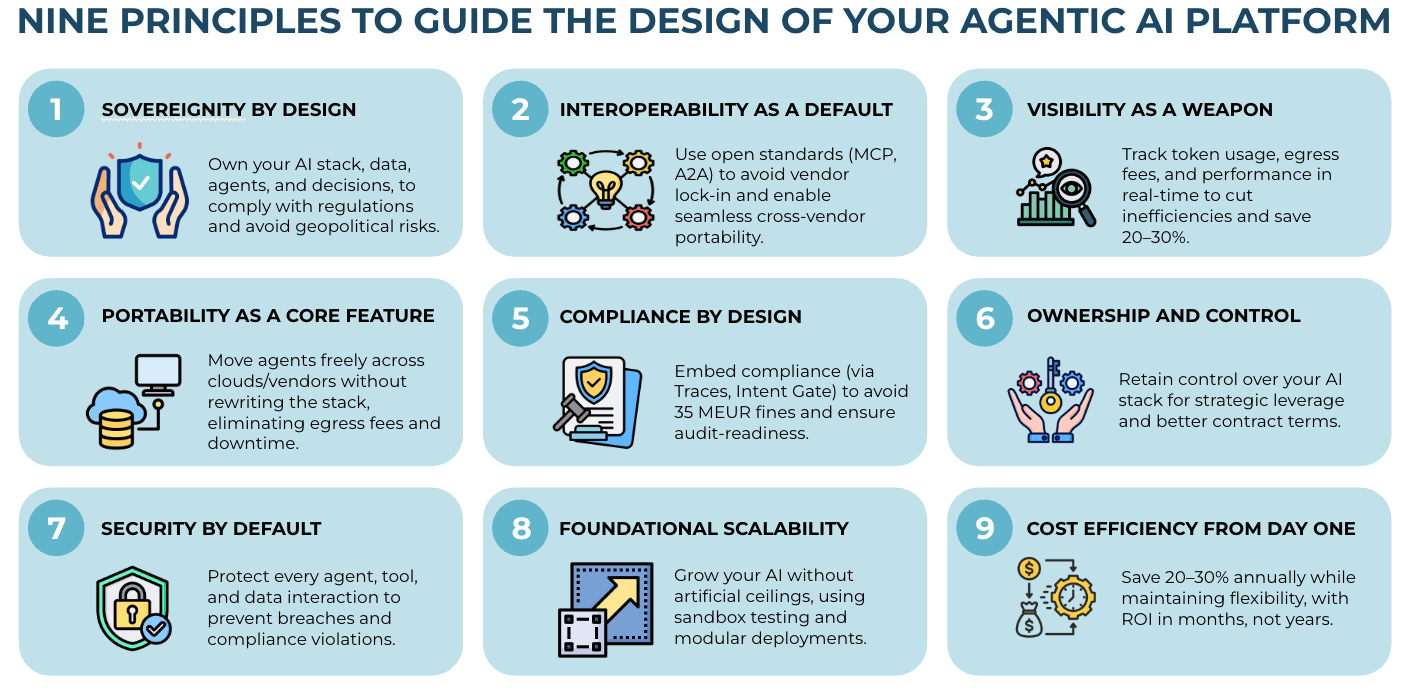

“ AI lock-in isn’t just a technical problem, it’s a strategic surrender. The nine principles we’ve embedded into Algorithma’s platform aren’t just features; they’re a declaration of independence. Sovereignty by design, interoperability as default, and visibility as a weapon: these aren’t buzzwords, they’re the foundation of an AI stack that answers to you, not your vendor. In a world where regulations, costs, and geopolitics shift overnight, the only sustainable advantage is ownership. We built our platform so our customers never have to ask for permission to innovate. ”
Sovereignty by design
In a world where 35% of countries will ban foreign AI by 2027 and the EU AI Act imposes fines for non-compliance, enterprises can’t afford to outsource control of their AI stack to hyperscalers or black-box models. Sovereignty means ownership: your data, agents, and decisions are yours alone.
| Feature/Tool | How it works | Outcome |
|---|---|---|
| Agent Registry | Maps vendor-specific IDs (e.g., "Copilot bot #59") to a stable, canonical name (e.g., "Customer Support Agent"). Enables portability across clouds. | Avoids vendor-specific tenant IDs and ensures clean ownership. |
| Immutable Traces | Logs every agent decision with a time-stamp and tamper-proof record for audits. | Proves compliance to regulators and builds trust with customers. |
| Jurisdiction-Specific Deployments | Deploys agents in EU-only, U.S.-only, or sovereign clouds to comply with data localization laws. | Ensures geopolitical resilience and compliance with local regulations. |
Interoperability as a default
Vendor lock-in thrives on proprietary protocols and siloed data. Interoperability breaks this by ensuring agents, models, and tools work together, regardless of vendor or protocol. This isn’t just technical flexibility; it’s strategic leverage.
| Feature/Tool | How it works | Outcome |
|---|---|---|
| MCP (Model Context Protocol) | Standardizes agent communication using an open protocol backed by OpenAI, Google, and Microsoft. | Enables cross-vendor portability and avoids proprietary APIs. |
| Agent Registry | Acts as a "normalization layer" to map Copilot, Snowflake, and custom agents under one identifier. | Allows seamless migration between clouds or vendors without rewriting governance rules. |
| Prompt Management | Treats prompts as managed artifacts (like code/config), enabling versioning, approvals, and reuse. | Prevents "prompt drift" and ensures consistency across teams. |
Visibility as a weapon
Hidden costs sink enterprises. 90% of AI workloads suffer from inefficiencies like redundant prompts or underutilized hardware, but these are invisible in closed systems. Visibility turns costs into actionable insights and compliance into a competitive edge.
| Feature/Tool | How it works | Outcome |
|---|---|---|
| Home Dashboard | A real-time "control panel" showing costs, latency, quality, and volume across all agents. | Identifies hidden inefficiencies (e.g., token waste, egress fees) in minutes. |
| Traces | Provides immutable logs of every agent run, with cost attribution per workflow. | Reveals 20–30% cost savings by spotting redundant prompts or unused tool calls. |
| Performance Reviews | Structures evaluations of agents based on business outcomes (e.g., resolution rate, compliance). | Turns raw logs into structured insights for quality, safety, and compliance. |
Portability as a core feature
As discussed earlier, 40% of agentic AI projects fail due to inflexible, single-provider architectures. Portability ensures your agents move with you, across clouds, regions, or vendors, without rewriting the stack.
| Feature/Tool | How it works | Outcome |
|---|---|---|
| Agent Registry | Decouples agent identities from vendor IDs (e.g., "Copilot bot #59" becomes "Customer Support Agent"). | Enables cross-vendor migrations with zero reconfiguration. |
| Unified Manamgement Suite | Provides one control plane for all agents, regardless of location (cloud, on-prem, edge). | Supports thousands of agents with 30–40% less downtime. |
| Agent Factory | Offers pre-built templates for common use cases (e.g., customer support, supply chain). | Reduces 60% of migration risk through sandboxed testing. |
Compliance by design
Regulators don’t accept promises, they demand proof. The EU AI Act, GDPR, and U.S. regulation impose fines. Compliance by design ensures you’re audit-ready from day one.
| Feature/Tool | How it works | Outcome |
|---|---|---|
| Intent Gate | Validates agent goals, tools, and permissions before execution, blocking restricted actions. | Prevents PII leaks, malicious tool calls, and compliance violations. |
| Immutable Traces | Provides tamper-proof logs for every agent decision. | Serves as audit evidence for regulators and internal reviews. |
| Sovereign Deployments | Runs agents in jurisdiction-specific environments (e.g., EU-only data centers). | Ensures compliance with local regulations (GDPR, EU AI Act). |
Ownership and customer control
Vendor lock-in isn’t just about costs, it’s about control. Enterprises that own their AI stack negotiate from a position of strength, avoid being held hostage to a provider’s pricing or roadmap, and future-proof their strategy.
| Feature/Tool | How it works | Outcome |
|---|---|---|
| Agent Registry | Acts as the source of truth for agent identities, ownership, and lifecycle. | Ensures clean governance and reliable business reporting. |
| Unified Management Suite | Gives one control plane for all agents, tools, and models. | Eliminates vendor-specific tenant IDs and strategic lock-in. |
| Prompt Management | Treats prompts as managed artifacts (like code/config), enabling versioning and approvals. | Prevents "prompt drift" and ensures consistency across teams. |
Security by default
| Feature/Tool | How it works | Outcome |
|---|---|---|
| Intent Gate | Blocks restricted data access and malicious tool calls before execution. | Prevents breaches, PII leaks, and compliance violations. |
| Traces | Provides tamper-proof logs for every agent decision. | Serves as audit evidence for security incidents and compliance reviews. |
| OWASP-Compliant Architecture | Embeds security best practices (e.g., input validation, least privilege) into the core platform. | Reduces attack surface and breach risk. |
Foundational scalability
The best AI strategy becomes useless if it can’t scale with your business or adapt to market changes. Scalability and modularity ensure your platform grows with you, not your vendor’s limits.
| Feature/Tool | How it works | Outcome |
|---|---|---|
| Agent Factory | Offers pre-built templates for common use cases (e.g., customer support, supply chain). | Enables phased scaling with 60% less risk. |
| Unified Management Suite | Supports thousands of agents across clouds, regions, and vendors. | Ensures no artificial ceilings on growth or complexity. |
| Sandboxed Testing | Validates portability and performance before scaling. | Reduces migration risk significantly. |
Cost efficiency from day one
AI lock-in is a budget killer. By eliminating inefficiencies, portability costs, and compliance risks, Algorithma’s platform pays for itself in months.
| Feature/Tool | How it works | Outcome |
|---|---|---|
| Traces | Reveals 20–30% cost savings by spotting token waste, redundant API calls, or underutilized hardware. | Cuts operational costs without sacrificing performance. |
| Agent Registry | Enables zero egress fees by decoupling storage, compute, and AI layers. | Eliminates hidden fees that inflate budgets. |
| Multi-model architecture | Adopting multiple specialized models, each optimized for specific tasks, reduces reliance on a single model or provider. | This increases resilience by enabling failover to alternative models when issues arise, minimizing workflow disruptions and vendor dependency. |

“ We built Algorithma’s platform so you own your agents, your data, and your future. Open standards like MCP, portable agents, and real-time cost visibility mean you’re never stuck, just always in control. ”
These nine principles aren’t just technical requirements, they form a strategic architecture that transforms AI from a cost center into a competitive tool. By embedding sovereignty, interoperability, visibility, portability, compliance, ownership, security, scalability, and cost efficiency into every layer of the platform, we ensure enterprises are no longer at the mercy of vendor lock-in, geopolitical disruptions, or regulatory fines.
Each principle is designed to pay for itself: Traces reveal hidden inefficiencies, Agent Registry enables seamless migrations, Intent Gate prevents breaches before they happen, and the Unified Management Suite future-proofs your stack without rewriting it.
The result? 20–30% cost savings, zero egress fees, faster feature rollouts, and the strategic leverage to adapt to market shifts. The choice is clear: Stay locked in and pay the price or own your AI stack and turn compliance, portability, and efficiency to your advantage.
The promise of artificial intelligence lies in its ability to drive business transformation, yet the current trajectory of single-provider dependence threatens to erase those gains through hidden costs and structural risks. As demonstrated, organizations trapped in proprietary stacks face a "lock-in cost" manifested through token waste, egress fees, and the looming shadow of regulatory fines.
To break free, enterprises must transition toward agent-native platforms built on the foundations of sovereignty, interoperability, and real-time visibility. By decoupling the AI layer from underlying infrastructure and adopting open standards like the Model Context Protocol (MCP), businesses can:
-
Realize annual efficiency gains by identifying redundant processes and optimizing resource allocation.
-
Accelerate Innovation: Roll out new features faster and reduce unplanned downtime through multi-cloud flexibility.
-
Navigate shifting geopolitical landscapes and strict data localization laws with audit-ready, jurisdiction-specific deployments.
The choice for leadership is no longer just about which model to buy, but who owns the intelligence powering the firm. By designing for sovereignty today, organizations ensure they remain agile, compliant, and cost-effective in an increasingly fragmented global market.