
What is the actual difference between Agentic AI and an AI Agent?
It is common to confuse AI Agents with Agentic AI, but an AI Agent is simply a task-focused tool that reacts to instructions, while Agentic AI is a system-level capability that proactively pursues goals and adapts through feedback. The key difference is that agents execute actions, whereas agentic AI takes ownership of outcomes by embedding reasoning, autonomy, and workflow accountability.
What is the actual difference between Agentic AI and an AI Agent?
Introduction
In the rush to adopt the latest technology, the industry has started using the terms “AI Agent” and “Agentic AI” interchangeably.
This is a mistake.
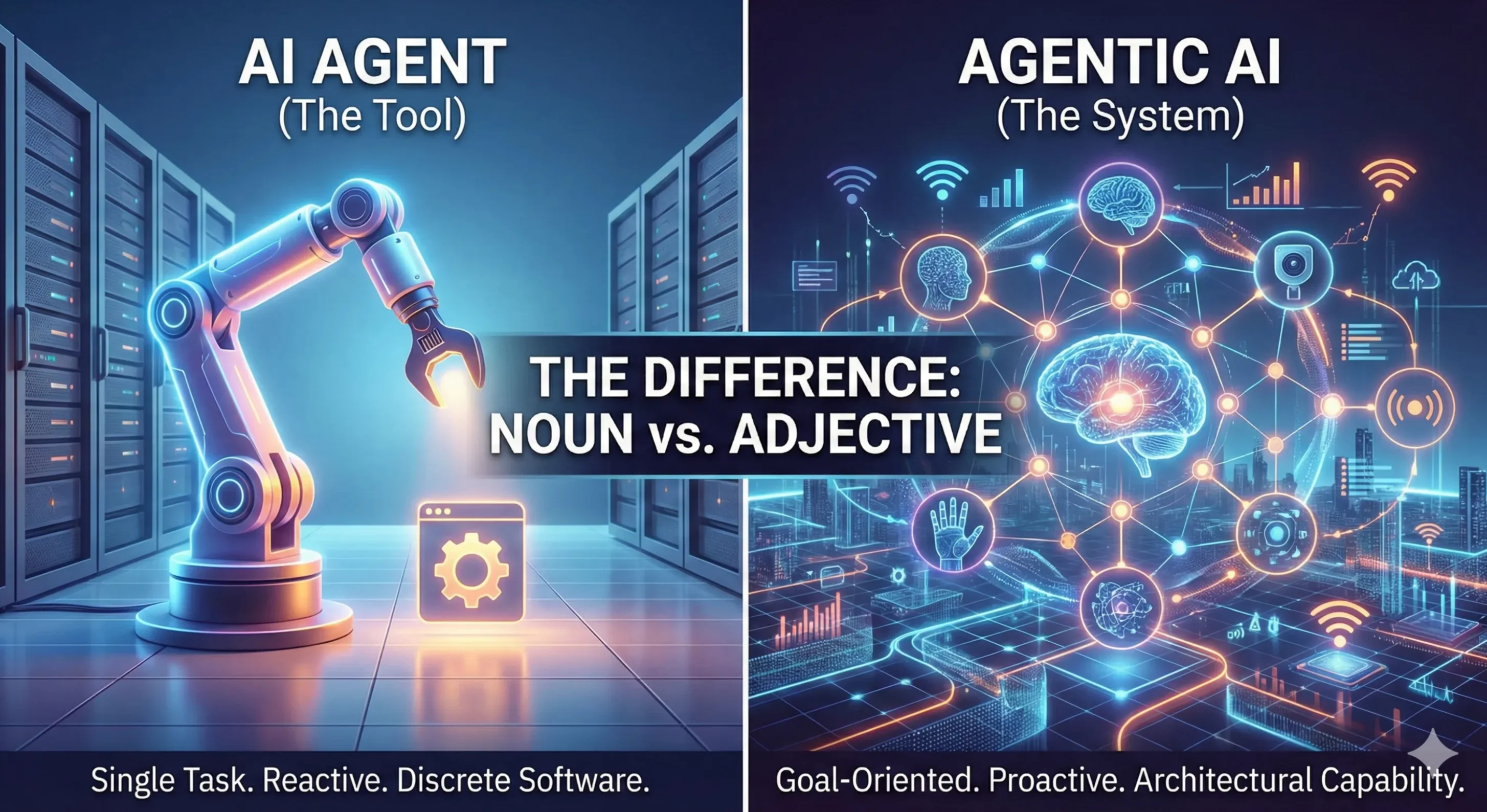
While they sound similar, they describe two fundamentally different things. One is a noun (a tool you build). The other is an adjective (a capability you design for). Understanding this distinction is the difference between deploying a cool demo and building a resilient enterprise system.
This confusion is costly. Gartner recently predicted that over 40% of agentic AI projects will be canceled by 2027, largely because teams underestimate the complexity of moving from “chat” to “action.” This happens when organizations focus on the tool rather than the workflow. As discussed in Agentic AI and the productivity disconnect, agentic AI only creates ROI when it’s embedded into workflows with accountability. Copilots and single-task assistants often feel helpful, but they don’t move the needle because they are measured by activity, not business outcomes.
The definitions
1. The AI Agent (The actor)
An AI Agent is a discrete piece of software. It is a worker.
OpenAI defines agents as systems designed to accomplish specific tasks using a defined set of tools.
- Example: You build a “Customer Support Agent” that has access to your Zendesk API and is told to answer FAQs or process refunds.
- The Mental Model: Think of an AI Agent as a single employee or a single machine on a factory floor. While they are far more capable than simple chatbots because they can take action, they are typically scoped to a specific domain.
2. Agentic AI (The capability)
Agentic AI refers to a system’s ability to exhibit agency.
It is the architectural approach that allows a system to pursue complex goals, reason through obstacles, and adapt its plans with minimal human oversight.
- Example: An “Agentic Workflow” that notices a sudden drop in website traffic, investigates the server logs, identifies a bad code deploy, and autonomously prepares a rollback plan for human approval.
- The mental model: This isn’t just a smarter bot; it’s a new operating layer. As outlined in Designing the AI-native enterprise (Algorithma), true agency requires protocol-based architectures that let agents coordinate safely at speed. Agentic behavior isn’t a prompt, it’s an operating layer that governs how agents perceive context, act via tools, and coordinate with one another.

“ Agentic AI is not a single agent doing more things. It is an architectural choice that allows systems to reason, act, evaluate outcomes, and replan without constant human direction. ”
The core difference: Task vs. goal
The easiest way to tell them apart is to look at how they handle inputs, failure, and results.
1. Input strategy
- AI Agent (The tool): Accepts specific commands (e.g., “Write this email”).
- Agentic AI (The system): Accepts high-level goals (e.g., “Increase lead conversion”).
2. Behavioral mode
- AI Agent: Reactive. It waits for input.
- Agentic AI: Proactive. It monitors the environment and acts when necessary.
3. Handling failure
- AI Agent: If it gets stuck, it usually halts and asks for help.
- Agentic AI: If it gets stuck, it replans and tries a new path.
- Note: Research shows that agents fail in production when they lack escalation logic, confirmations, and an operational layer.
4. Expected output
- AI Agent: Content or Single Actions.
- Agentic AI: State Change (e.g., A database update, a solved ticket).
- Note: We must measure AI maturity by work owned (Span of Responsibility), not model metrics.
What does “Agentic” actually mean?
When we say a system is “Agentic,” we don’t just mean it is autonomous. We mean it follows a cognitive loop that mimics human problem-solving, a concept rooted in the ReAct framework (Reasoning + Acting):
- Perception: It reads the environment (not just the user prompt).
- Reasoning: It breaks a high-level goal into a plan of steps.
- Action: It uses tools to change the world (send email, query DB).
- Evaluation: This is the critical step. It looks at the result of its action and asks, “Did that work?” If yes, it proceeds. If no, it self-corrects.
This evaluation step is where most projects break. It is crucial to understand that hallucinations in enterprise agents are a design problem, not a model flaw. If you want agency, you need feedback loops and supervision patterns, not just a smarter model.
Generative AI creates content. Agentic AI drives results.
While Generative AI focuses on producing text, code, or images, Agentic AI focuses on using those outputs to use tools and change the state of a system.
What Agentic AI enables
Why does this distinction matter for your business? Because if you treat agents as just “smarter chatbots,” you miss the operational value. “Agentic AI” enables entirely new ways of working.
1. Asynchronous execution (“Fire and forget”)
With a standard conversational interface, you often have to guide the bot. With an agentic system, you assign a goal - “Research these 50 competitors and update the CRM” - and walk away.
However, autonomy introduces risk. As you scale, as agents gain responsibility, security and governance must be built into the workflow. The more agentic the system, the more your design has to formalize boundaries, permissions, and escalation.
2. Multi-step reasoning & reusability
A single agent often struggles with long, conflicting instructions. An agentic approach breaks the problem down. It creates a “Researcher” to find data, an “Analyst” to interpret it, and a “Reviewer” to check it.
The hidden benefit here is compounding value. Once the system learns a workflow, agentic AI captures how work gets done and makes it reusable. You aren’t just running a script; you are building a corporate asset that teaches itself.
3. Self-correction & reliability
This is the holy grail. In a brittle system, if an API call fails, the process crashes. In an agentic system, the AI sees the error, reasons “The API is down, I should try the backup database,” and continues.
Conclusion
If you are looking for a tool that executes specific tasks, you are looking for an AI Agent.
But if you are looking to build a system that takes ownership of a business process, you are building Agentic AI.
The former is a software purchase. The latter is a shift in how work gets done. As we move forward, we will see AI agents as digital colleagues that operate across systems, not inside one app.
The technology is ready. The question is, what are you building?