
Why rebranding GenAI “agentic AI” slows down the real transformation
Enterprises are rebranding standard GenAI as “agentic AI”, but most deployments still behave like co-pilots bolted onto unchanged workflows. True agentic AI is not a label. It is an operating-model shift where digital colleagues take responsibility for outcomes, coordinate across silos, and improve through feedback. Without redesigned decision rights, governance, and learning loops, “agentic” becomes semantics and slows real transformation.
Why rebranding GenAI “agentic AI” slows down the real transformation
Introduction
Enterprises are rapidly rebranding standard GenAI deployments as “agentic AI,” even when the underlying capability remains little more than a co-pilot-like assistant. The label promises autonomy, coordination, and continuous learning, but most implementations operate like upgraded utilities. When organisations adopt the agentic vocabulary prematurely, they are signalling an operating-model shift they have not actually made. GenAI is being used as a feature, while agentic AI requires a change in how work is designed, executed, and improved.
AI adoption follows a predictable pattern. Launch pilots, report activity, celebrate incremental productivity improvements, avoid touching the core operating model. This creates a comfortable illusion of progress, even though nothing fundamental in the organisation changes. GenAI is absorbed into this pattern as a bolt-on to existing workflows. When it gets relabelled as “agentic,” the disconnect becomes visible. What is being described as agentic behaviour is often just a chain of prompts and rules masquerading as autonomy.
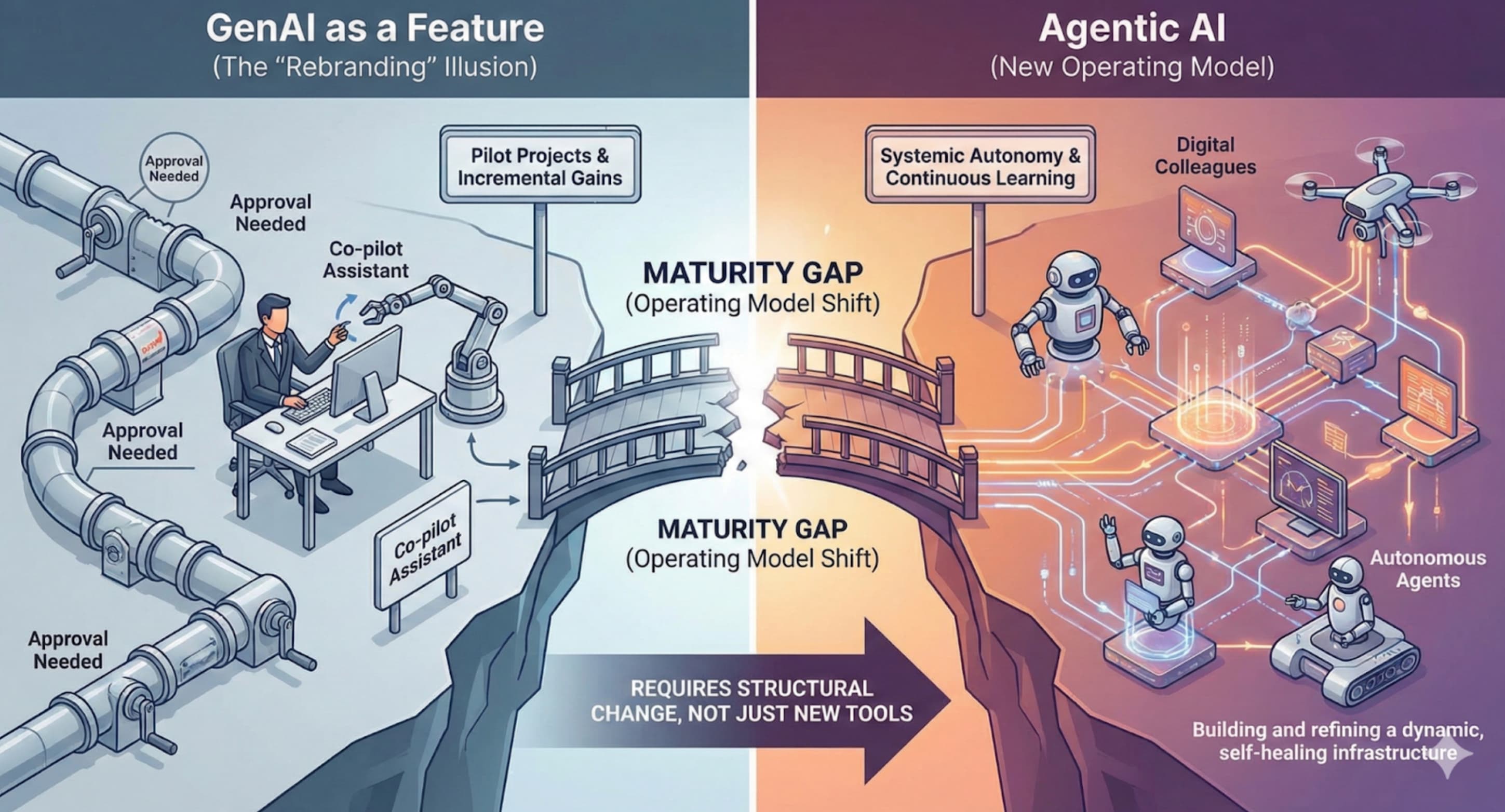 The common friction points look familiar:
- Create isolated pilots, but never connect them into a system
- Build GenAI features, but never redesign the surrounding work
- Promise transformation, but deliver utilities
- Talk about autonomy, but govern like nothing can move without approval
Agentic AI is not a rebranding exercise, it is a new operating model. Using the name too early only highlights how far most organisations still are from implementing one.

“ Every time we call a GenAI assistant an agent, we quietly shift the burden from the system to the people. Instead of AI adapting to the organisation, the organisation ends up adapting to AI. Real agents reverse that equation. They take on work, they don’t create more of it. ”
From co-pilots to digital colleagues
A co-pilot supports the worker, while an agent performs work within a defined scope. Enterprises understand this distinction on paper, but their implementations rarely reflect it. What they call agentic behaviour is typically deterministic task execution, not adaptive, coordinated work. Advanced models do not create maturity on their own. Maturity emerges when systems allow AI to act independently, connect across functions, and improve through feedback. GenAI that cannot operate beyond a prompt window is not an agent, it is a tool.
Actual agentic systems behave differently. They:
- Create workflows that run without human micromanagement
- Connect information across silos so learning compounds
- Take responsibility for multi-step processes
- Reduce operational drag by orchestrating outcomes rather than tasks
AI is able to take on operational responsibility, not only assistant duties. This moves the organisation from struggling GenAI adoption to agentic transformation. That shift is structural, not only semantic.
Why GenAI demands heavy change management and agents do not
GenAI systems rely on humans to initiate, steer, interpret, and complete the work. They add capability, but they do not change the underlying mechanics of the workflow. Because of this, GenAI deployments carry a significant change-management load. Teams need to learn prompting, adopt new interfaces, adjust processes, and integrate AI into daily routines. The technology only creates value if humans adapt their behaviour around it, a process that is slow and expensive.
Agentic AI operates differently. An agent performs defined tasks autonomously, coordinates steps, and delivers outcomes without the user orchestrating every move. The workflow stays largely intact because the agent fits into the operational model instead of asking people to redesign their day. The organisation does not need to train employees to “use” the agent, because the agent is doing the work.

“ Trust in AI is built the same way trust in new colleagues is: give them low-variability, low-complexity work, let them prove reliability, then expand the scope. Agentic transformation isn’t a leap, it’s a sequence of steps. ”
What enterprises should do next
Digital colleagues are not extensions of existing workflows, they are participants in them. When AI moves from assisting to acting, the operating model becomes the real bottleneck, not the technology. Organisations that continue to frame AI as a feature will keep redesigning human behaviour, while organisations that frame AI as a colleague will redesign the system itself.
The next steps are structural, not tactical:
- Map the work, not the tasks. Identify where outcomes can be owned by digital colleagues rather than broken into human-centric steps.
- Define where decision rights live. Agents need clear boundaries for action, escalation, and improvement.
- Establish learning loops as part of operations, not as side projects. Agents should accumulate experience the way teams do.
- Redesign governance to support autonomy, not micromanagement. If every action needs approval, nothing scales.
This shift requires discipline. Early agents should take on low-variability, low-complexity work where procedures are stable and outcomes are predictable. This is where trust is earned and reliability is proven. Starting here reduces operational risk, accelerates adoption, and builds the confidence needed to expand agents into higher-value processes. In other words, you scale the operating model at the same pace as the organisation’s trust in digital colleagues.
Algorithma guides organisations through this evolution with AI inception, AI agent delivery, AI sustainment, and AI agents as a service, helping enterprises build the operating models where digital colleagues can actually work.