
The AI edge is not where everyone is looking
SaaS isn't dying. The value is moving to a different layer, and so is the data that feeds it. There are two ways to get that data. One is slow and expensive. The other is now possible, and it compounds.
The AI edge is not where everyone is looking
Introduction
Everyone keeps writing that SaaS is dead. I don't buy it. The value is moving to a different layer, and that is a quieter and more interesting story than the headlines.
We had two decades where writing software was the expensive part. So vendors built platforms and you adapted your company to fit them. Now code is close to free, and when the expensive input becomes cheap, the logic of where the competitive edge sits changes. But code is not the only input getting repriced. The data that feeds these systems is going through the same shift, and almost nobody is talking about that part.
The customization trap, again
I keep coming back to the ERP years to make sense of this. We all watched companies spend millions customizing SAP to fit how they actually worked, and then get stuck, because the customization was the very thing that made every upgrade a nightmare (yeah, I did my fair share of this also). A migration from ECC to S/4HANA could turn into a multi-year, multi-million project. The punishment for being yourself, basically.
That tension comes from a simple fact; software was scarce and expensive to build, so the smart move was to standardize and ask everyone to conform. Agentic AI mostly removes that tension. The software adapts to the workflow now, instead of the other way around. An agent can generate the interface, stitch the APIs together, and work off the messy real process rather than a set of predefined fields. At Algorithma we have replaced or built apps for email marketing, CRM, operations and business control, from scratch and fitted to our processes. They are not, and will not, become SaaS, they are just our software for our process.
The more interesting question is what is left to defend once software is easy.
Two ways to get the data
Here is where I think the common wisdom may be coming up short. The usual answer is: your proprietary data is the moat. The years of tickets, transactions and documents you have piled up that nobody else has. I think that is only half right, and it is the expensive half.
There are really two ways to get the data that makes an AI system good at your specific work. The first is the one everyone is doing. You take the history you have accumulated, and you spend months cleaning it, mapping it, labeling it, and wiring it into the model. It is a big upfront project, and it is slow. And by the time you are done, the world has often moved on, because operational data ages. A support log from 2021 encodes a product, a policy and a customer base that don't exist anymore. Making it useful isn't cheap.
The second way is newer and it is cheaper. Instead of mining the lake, you capture data as a byproduct of doing the work. Your experts react to this week's edge case, someone makes a correction, an agent runs a task and a human fixes what it got wrong. Each of those is a new, labeled, decision-relevant data point that arrives with the right answer already attached, which is the part that makes the old lake so expensive to label by hand. The lake is a “stock of data” you paid for over years and pay again to clean. The new data flow you get for free, just by doing the work.
To be clear, these are complementary. You usually need some history to ground an agent. We use existing data on basically every install, so I am not going to pretend the lake is worthless. But grounding is not the moat. Your data stock gets you to the starting line, but putting the new data to work is the untapped opportunity.
That is the blunt version and I mean it. Most organizations have it backwards. They are still funding a multi-year data-lake program as if accumulation is the win, while underinvesting in the thing that actually generates advantage: the speed at which they turn live operations into new data, faster than their world changes around them. This is the one thing the AI models don't have… yet: an understanding of business processes post-implementation of AI.
The seat license is on the wrong side of this
This reframes the pricing debate too. "One human, one seat, one unit of work" stops meaning much when one agent runs a thousand processes at night while everyone is asleep. The per-seat model measured access, and access used to be a decent proxy for value, but it isn't anymore.
The numbers here are genuinely contested, so take them as direction rather than gospel. Gartner expects that by 2030, at least 40% of enterprise SaaS spend will shift toward usage-, agent-, or outcome-based pricing, and that 35% of point-product SaaS tools will be replaced by agents or absorbed into larger agent ecosystems. [1] Deloitte projects seat-based vendor revenue share falling from 21% to 15%. [2] You will also see far punchier figures floating around. I would not lean on those. The honest version: pricing tied to human headcount is structurally exposed, and the institutions with real data agree on the direction even if nobody knows the exact slope.
Vendors are already reacting
You can watch it happen in the price lists. Zendesk, Intercom and Salesforce have all moved to some version of a platform fee plus a charge per resolved outcome. Zendesk charges per autonomously resolved ticket, Intercom around €0,90 per AI-resolved conversation through Fin, Salesforce prices Agentforce on completed actions. [3] Bessemer reckons roughly 92% of AI software companies now use some mixed model with a usage component. [4]
The math caught me off guard the first time I worked through it. In a typical support example, the software bill actually goes up, because you now pay per resolution at volume. But the customer's total operating cost drops sharply, because the headcount it replaces dwarfs the software line. Which explains the thing people find counterintuitive: it is the buyers pushing for outcome pricing, not the vendors.
##One caveat, because the hype skips it This is not magic. MIT's NANDA initiative looked at this closely in The GenAI Divide: State of AI in Business 2025 and found that around 95% of enterprise GenAI pilots delivered no measurable P&L impact. [5] The detail that matters, and the part I would underline, is why. It is almost never the model. It is the integration, the messy data, the gap between a pilot and a workflow that actually sticks.
Read that again, because it is exactly the slow expensive path from section two. Most pilots die in the data swamp: cleaning history, mapping it to legacy systems, discovering the distribution shifted while they were at it. The 95% is not evidence that AI does not work, it is evidence that the old way of feeding it does not scale.
Why we build the way we do
This is roughly the reasoning behind how we built our platform approach. Governance, the agent factory and the runtime, all sitting behind the client's firewall. We were never betting on having the cleverest model. We were betting on the data flow: the thing that captures what your experts know, generates new labeled data as the work happens, and keeps improving in production, with the data staying yours.
If the argument above is right, that is where the competitive edge lives. Not in the code, which is becoming a commodity. Not even in the legacy data, which everyone has a version of. It lives in the speed of change, and the domain expertise feeding it. Code stopped being the product a while ago. It is the pipe now. And the data that matters is the data you don't have yet.
Which raises the obvious question, if that data is the asset, where does it actually come from? That is the part most people haven't worked through yet, so it is worth being concrete.
What to do next
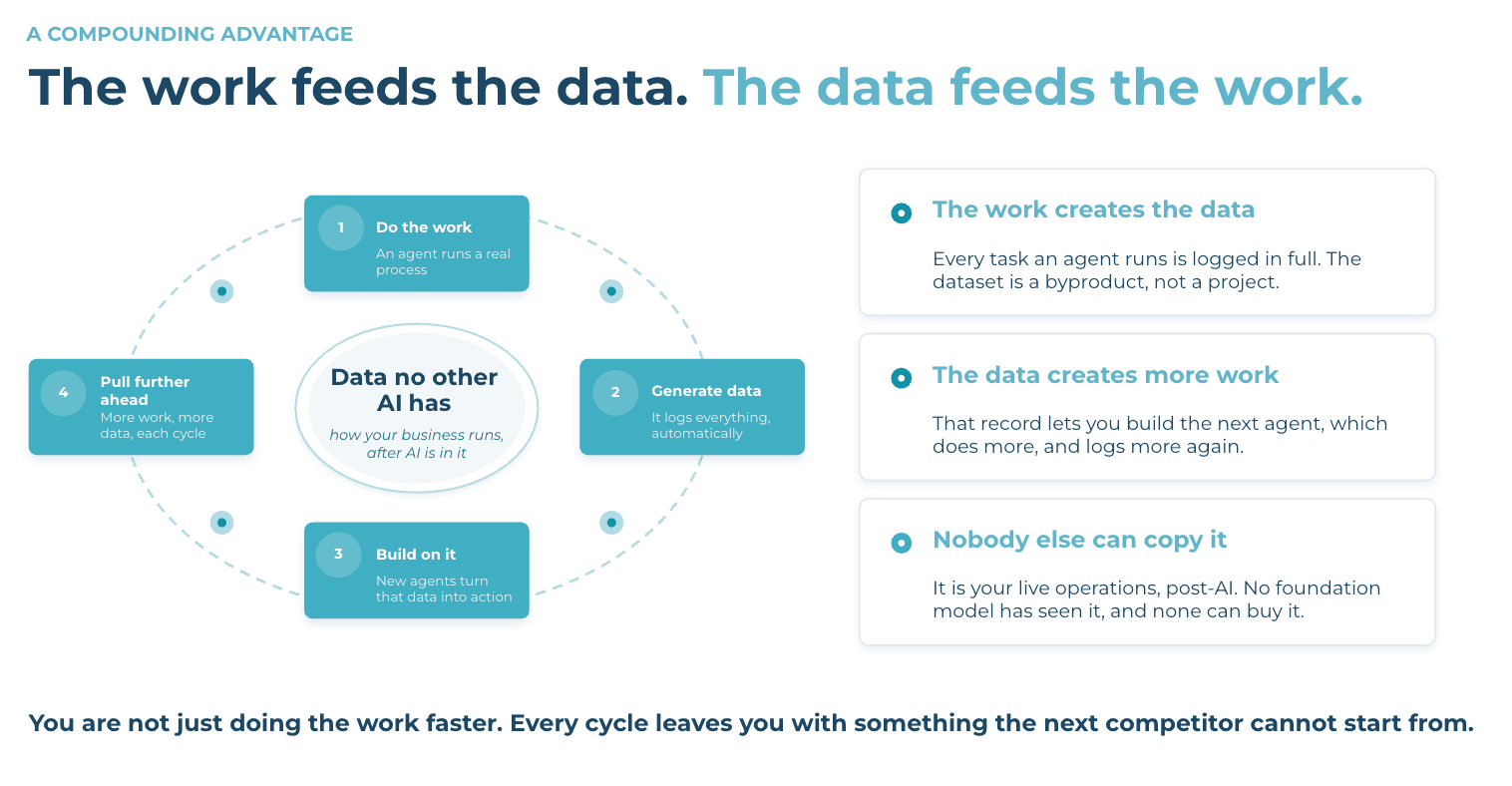
When an AI agent does a job, it logs everything. Every step, every input, every call it made, the reasoning, the outcome. Completely, automatically, every time. Not because someone built a clever data pipeline, but because it's software and that's what software does.
A human doing the same job leaves almost nothing behind. Think about what's actually recorded when a person scores a supplier submission. A final decision, maybe a note. The reasoning, the things they checked, the judgment calls, all of it stays in their head and disappears. You ran the work and captured none of it.
Now put an agent on supplier scoring under NIS2. Every submission, every criterion it weighed, every decision and the basis for it, logged. You get a faster process, sure. But you also get, as a byproduct, the most complete record of how your organisation actually makes those decisions that has ever existed.
This is the foundation you build the next thing on. Because once you have the complete log of every scoring decision, you can put a second agent on top of it. An insight agent that reads across all of it and sees what no individual scorer ever could, your actual risk exposure across the entire supply chain, and acts on it. That insight is itself new data. So you put a third agent on that, a learning agent that compares the insights against your real supplier agreements and finds the gaps, the clauses that don't match what's happening on the ground. More new data. Then a fourth, a support agent that goes back to suppliers with concrete best practice, creates real value for them, and logs how they respond. More data again.
Each layer does useful work. And each layer throws off a new dataset that the next layer feeds on. The value compounds, because you're not just doing the work faster, you're building a system where every piece of work makes the next piece smarter. A human alone never reaches this, there aren't enough hours. A pile of dumb automation never reaches it either, because it doesn't learn. You only get it when humans and agents work in tandem, the agents running and logging at speed, the people curating and correcting and deciding where to point it next.
That's the whole argument of this piece in one example. The moat was never the software. It's the dataset the work generates, and the stack of agents you build on it, compounding faster than anyone starting later can catch.
So, what to actually do.
- Own the logs. This is the whole game and it'll be buried in a contract. The agents are generating the most valuable record your organisation has ever had of its own operations, and everything you build later sits on top of it. If the vendor owns that data, or it lives somewhere you can't extract it, you've handed away the foundation and kept the bill. Own the logs or don't sign.
- Stop treating your team as a cost to remove. The old instinct says the agent replaces the a person and you book the saving. But the agents learn what to log, how to decide, and what counts as a good outcome from somebody, and that somebody is your best people. They're the only scarce input in the whole stack. Point them at the system so their judgment is in it while they're still here, rather than cutting them and losing the one thing that wasn't a commodity.
- Stop waiting to be ready. Every month spent scoping is a month not logging, and you cannot backfill it. The org that gets one imperfect agent into production starts accumulating the foundation immediately, and can start stacking on it. The one running a two-year readiness review just chooses to have nothing to build on while a competitor compounds. There's no catching up on a dataset you didn't start collecting.
None of this is a procurement exercise. It's understanding that the moment an agent does the work, you start writing down how your business actually runs, and then you build on that record, layer after layer, each one feeding the next. That compounding is the asset. Make sure it's yours.
A note on the numbers: enterprise AI statistics move fast and the punchiest figures often trace back to a single secondary source. Where the data is contested I have said so, and leaned on Gartner, Deloitte and MIT rather than the louder estimates. Treat the forward-looking figures as direction, not precision.