

Introduction
AOS is Algorithma's operating system for enterprise AI agents. It runs inside the customer's own environment and gives the organization one place to run, connect, observe and manage agents across different clouds, models, frameworks and business applications.
The reason for AOS is simple: the enterprise agent estate will not be built in one place. Some agents will be developed by internal teams, some will come with platforms such as Salesforce or ServiceNow, some will be delivered by partners, and more will be created directly by business users. The technology used underneath them will keep changing.
AOS provides a common layer across that mix. Runtime handles execution inside the customer's infrastructure. Core provides shared integrations, tools and patterns for building and connecting agents. Control gives IT and the business a common view of what is running, how it performs and what controls apply. Existing agents can also be brought under AOS management without being rebuilt from scratch.
AOS sits above the cloud, model and application choices used to build individual agents. Its role is to keep the operating model under enterprise control while those choices change. Business teams can move quickly, while IT keeps hold of identity, security, telemetry, governance and production standards.
That matters more than most organizations expect, and we have witnessed it firsthand. By agent three, teams are already repeating decisions around access, integrations, evaluation, monitoring and ownership. AOS is designed so that each new agent can reuse what has already been solved, rather than start again as a separate project.
The AI agent portfolio will grow from “the edges”
The enterprise agent estate will not be created only through centrally sponsored programs. AI app builders, vibe coding, and AI services are lowering the cost of turning business ideas into working software. Product managers, analysts and operations teams can now prototype, and sometimes deploy, applications that previously required an engineering queue. The UK National Cyber Security Centre describes shadow AI as already widespread and warns that when approved tools and policies do not meet business needs, employees will continue adopting AI services before organizations have assessed them.
This is an adoption dynamic, not primarily a user-behaviour problem. If the governed path is materially slower than the ungoverned one, business users will find another path. AI-assisted citizen development makes applications, automations and agents easier to create, while creating ownership and support problems after deployment.
For AOS, this expands the role of the operating layer. The goal cannot be to force every experiment through central IT. It is to create a path by which useful experiments can become known, reviewed, integrated and operated as enterprise assets. That means separating experimentation from production authority, bringing successful business-built agents into a registry and common telemetry model, and applying stronger controls as they move closer to sensitive data or consequential actions.
The agent estate will therefore grow in two directions: top down through strategic platform programs, and bottom up through business-led creation. AOS needs to make those two paths converge before shadow AI becomes shadow infrastructure.
AI platform landscape
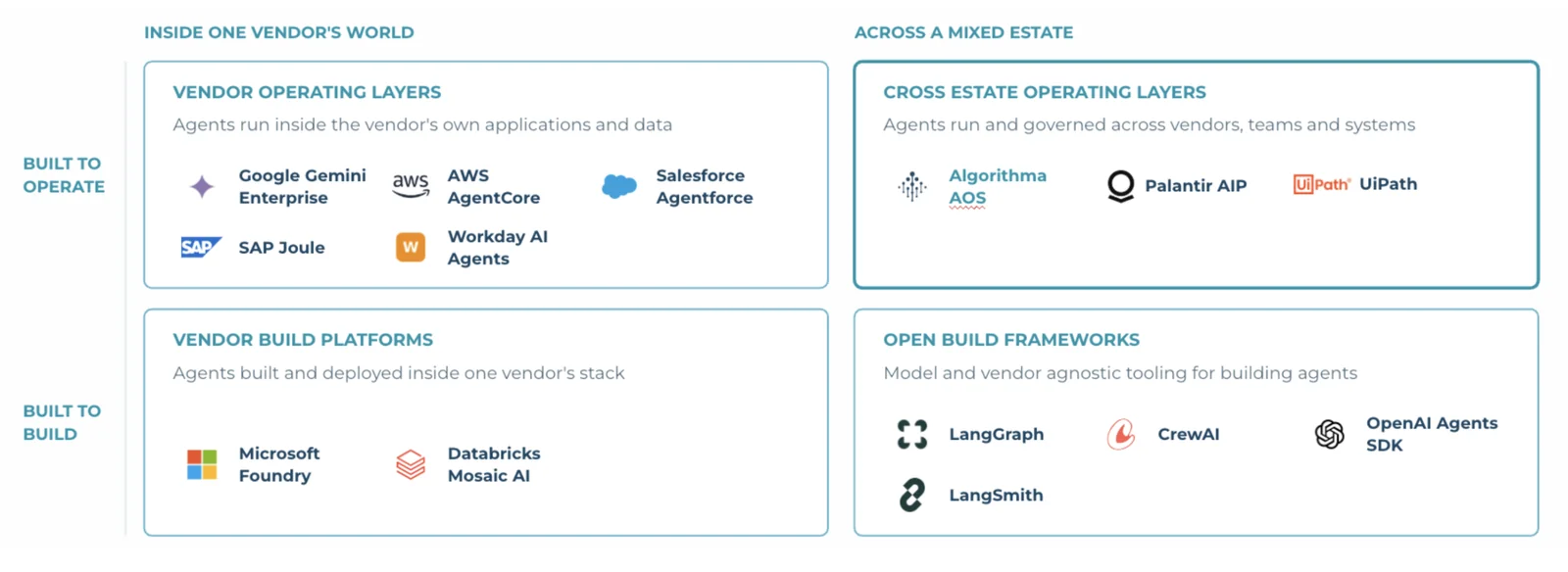
The market is separating along two practical dimensions: whether a platform is primarily built to build agents or to operate them, and whether its natural boundary is one vendor ecosystem or a mixed enterprise estate. These are not feature scores. Most serious platforms increasingly do some of both. The distinction is what they are built around.
The mixed estate is already the normal enterprise condition. Mergers, siloed application teams, SaaS sprawl and inherited architectures are common reasons. AI agents will inherit that landscape rather than replace it.
Vendor operating layers
Google Gemini Enterprise, AWS AgentCore, Salesforce Agentforce, SAP Joule and Workday AI Agents extend agent capabilities through the vendor's own applications, data and infrastructure. Their strength is the depth of context and control available inside that ecosystem. Organizations that choose to standardize their agent estate around one vendor can use that vendor's operating layer as the natural control point.
Vendor build platforms
Microsoft Foundry and Databricks Mosaic AI provide integrated environments for building, deploying and managing agent applications from a cloud or data platform. They combine development tools with runtime, evaluation, identity, observability and governance capabilities. Their centre of gravity is the creation and operation of agents from within the vendor's stack.
Open build frameworks
LangGraph, LangSmith, CrewAI, the OpenAI Agents SDK and similar tools give development teams flexible ways to define agent behaviour, workflows, tool use, evaluation and tracing. They are designed around the application and engineering lifecycle and can sit across model providers and infrastructure choices.
Cross-estate operating layers
AOS, Palantir AIP, and UiPath start from the problem of operating AI across a wider enterprise estate. Their natural boundary reaches across teams, systems and, to different degrees, technology providers.
Palantir approaches this from a broad data and operational platform. AIP can run with customer-hosted models and supports on-premise and air-gapped deployment where required. ServiceNow extends from workflow and service management, while UiPath extends from automation across software robots, systems, agents and people.
AOS starts specifically from the agent estate. It is designed to run inside the customer's environment and provide one operating model across agents built on different clouds, frameworks, models and business applications. The starting point is not a particular cloud, application suite or automation platform. It is the enterprise's own agent estate.
The chart therefore makes two distinctions. From left to right, the operating boundary moves from one vendor ecosystem to a mixed estate. From bottom to top, the primary job moves from building agents to operating them. AOS sits in the upper-right because it is built to operate agents across a mixed enterprise environment.
Sovereignty is part of the same position. It is not only a question of data residency, but of who controls the runtime, identities, policies, telemetry, model access and operational data that define how agents are run. AOS keeps that operating layer inside the customer's environment, so the enterprise retains its governance model as the underlying technology changes.
Where AOS fits in the enterprise
AOS is built for enterprises that expect agents to come from several clouds, applications, vendors and teams. It provides a stable operating layer across that estate, inside the customer's own architecture. Azure, AWS, Google Cloud, Salesforce, ServiceNow and open frameworks can all remain part of the stack. AOS provides the common control and reuse layer across them.
In practical terms, AOS has three linked parts. AOS Runtime is the execution layer inside the customer's environment, where agents run against enterprise systems and data. AOS Core provides shared capabilities for building the next agent faster, including integrations, tools, patterns, evaluation and deployment components that can be reused rather than rebuilt. AOS Control is the management layer across the estate, bringing together the agent registry, traces, performance, quality and lifecycle information. Together, Runtime, Core and Control turn the operating layer from an architecture idea into something the enterprise can install and use.
There are three practical ways into AOS. A team can configure an existing agent pattern, build a custom agent on the shared platform, or bring an agent that already exists under AOS management. Moving onto the platform does not have to start with a rebuild.
This is already being used in production across retail, e-commerce, manufacturing, security, real estate, insurance and facility management. The useful pattern is not only that the first agent can reach production, but that the work around infrastructure, security, monitoring and governance is then reused for the next one.
One customer describes the shift this way: “For us, it was not just about the individual AI use cases, it was about building a foundation to scale AI securely across the organization.”
This is where the economics start to compound. The first production agent establishes capabilities that later agents can reuse: approved infrastructure, deployment patterns, tools, connectors, evaluation methods and governance controls. Each subsequent implementation should add to that shared foundation. The practical test is simple: agent number 20 should not cost as much or take as long to create as agent number 1.
For IT: a stable operating layer
For IT and enterprise architecture, AOS provides a way to separate the operating model for AI from the technology choices underneath it. The enterprise can continue to use the cloud platforms, models and frameworks that make sense for each use case while retaining a common approach to ownership, telemetry, evaluation, lifecycle management and governance. This gives IT a stable layer to manage even as the technology estate continues to change.
The split in responsibility is also by design. Business teams own the workflow, prompts and performance targets. IT owns the infrastructure, compliance and system health. AOS sits between the two, so the business can change how an agent works without taking over the technical controls around it.
The same principle applies to ownership. The infrastructure code, prompts, telemetry and operational data remain with the customer. That matters because the operating model should not disappear if a model provider, cloud platform or framework changes. The “knowledge” layer stays with the AOS user.
AOS can also bring existing agents under a common management model without requiring every agent to be rebuilt on the same framework. The degree of control depends on the depth of integration. At a basic level, an external agent can be registered with an owner, purpose and production status. With trace integration it can be observed and evaluated using common metrics, while deeper runtime or tool integration allows stronger execution controls. The principle is straightforward: control requires integration, but integration does not require architectural uniformity.
For the business: a faster path from experiment to production
The rise of business-led AI development makes this equally important outside IT. Teams will increasingly build prototypes, agents and small applications themselves. Trying to stop that is unlikely to work, and it risks making the governed route slower than the ungoverned one. A better model is to let experimentation happen while creating a clear path for successful solutions to become known, reviewed and operated as enterprise assets.
AOS is intended to make that transition easier. Business teams can move quickly at the edge, while IT can apply stronger controls as an agent moves toward production, sensitive data or consequential actions. The result should be governance that enables adoption rather than governance that becomes the reason people work around the platform.
For management: from AI projects to an AI portfolio
As the number of agents grows, management needs a different view of AI. The relevant questions are no longer only whether an individual agent works, but which agents exist, who owns them, what they cost, how they perform, what they can access and where the organization should invest next. AOS Control is designed to provide that portfolio view across the agent estate, combining registry, traces, performance data and lifecycle information into one operating model.
This is ultimately the business value of AOS. It allows the organization to accumulate capability rather than accumulate projects. Integrations can be reused, operating lessons can become platform standards, evaluation patterns can carry across use cases and the cost of the next agent can fall as the estate grows.
AOS has been shaped through production deployments rather than only as a reference architecture. Across current implementations, the recurring lesson is that enterprise complexity does not disappear when better AI models arrive. Identity, approvals, auditability, integrations, maintenance and operational responsibility still have to be solved. A platform creates value when those problems are solved once and then reused rather than rediscovered by every new team.
An enterprise does not need to standardize every agent on one technology. It does need a common way to bring agents into production, see what is running, apply the right controls and reuse what has already been built. The operating layer should be established before fragmentation becomes the architecture.
AOS is designed to be that layer.